Oil and Gas in Libya: Current Status, Challenges and Outlook
Libya holds Africa's largest oil reserves and sits close to key European markets. This report reviews its reserves, infrastructure, economy, challenges and long-term outlook.
 By the editorial teamPetrole.Africa
Introduction
Libya occupies a strategic position in the global energy landscape, not only because of its vast hydrocarbon resources but also because of its geographic proximity to key European markets. At the start of 2024, the country held 3% of the world's proven oil reserves and 41% of Africa's, making it an essential player despite persistent challenges. In 2021, Libya was the seventh-largest crude oil producer within OPEC and the third-largest producer of petroleum liquids in Africa. Its crude is particularly prized for its high quality, often described as "sweet crude oil".
Libya's oil and gas sector is marked by a striking paradox: immense potential held back by persistent political instability and infrastructure degradation that have lingered since 2011. Despite these considerable obstacles, renewed international interest and ambitious national plans aim to revitalize production. This report offers an in-depth analysis of the current state of the oil and gas industry in Libya, examining its reserves, production capacity, the condition of its infrastructure, its economic role, the structural challenges it faces, investment opportunities and long-term prospects.
I. Current Reserves and Production
A. Crude Oil: Capacity, History and Recent Trends
Libya has proven oil reserves estimated at 43.6 billion barrels , and even 48 billion barrels according to other estimates , the largest in Africa. This considerable geological potential contrasts with the historical volatility of its production.
Crude oil production has been extremely unstable, frequently interrupted by conflicts, social disputes, budget constraints, maintenance problems and insufficient storage capacity. Between January 2002 and January 2025, average production stood at 1,177,000 barrels/day, based on 277 recorded observations. The all-time peak was reached in March 2008 at 1,752,000 barrels/day, but production fell to a record low of 7,000 barrels/day in August 2011. Since 2011, the country has never consistently regained its 2008 production level.
Recent trends show a recovery. In January 2025, production was 1,277,000 barrels/day, up from 1,260,000 barrels/day in December 2024. In December of the previous year (probably 2024), Libya produced 1.4 million barrels/day, its best figure since 2013. In May 2025, production reached a 12-year high, standing at 1.23 million barrels/day. The country aims to reach 1.6 million barrels/day by the end of the year and 2 million barrels/day by 2028.
One notable feature is Libya's exemption from OPEC+ production cuts, which gives it strategic flexibility to raise output when conditions allow. This exemption is generally granted to countries facing significant internal disruptions. It gives Libya a strategic advantage, allowing it to increase production without being constrained by the cartel's quotas if and when its internal conditions stabilize. This positions Libya as a potential "swing" producer if it manages to overcome its domestic challenges, able to quickly add significant volumes to the global market, which is particularly attractive to international buyers, especially European ones.
The contrast between Libya's considerable reserves (the largest in Africa) and its current production, which remains well below its historical peak, shows that production capacity is not limited by geological endowment but by persistent geopolitical and operational instability. This means that any sustained increase in production will depend on political stability and infrastructure rehabilitation, rather than on new discoveries alone.
The following table illustrates the evolution of crude oil production in Libya:
Table 1: Crude Oil Production in Libya (2002-2025)
| Period | Production (Barrels per Day) | Notes |
|---|---|---|
| Jan 2025 | 1,277,000 | Increase from Dec 2024 |
| Dec 2024 | 1,260,000 | |
| Average (Jan 2002 - Jan 2025) | 1,177,000 | Based on 277 observations |
| All-time high (Mar 2008) | 1,752,000 | |
| All-time low (Aug 2011) | 7,000 | |
| Dec 2024 (estimate) | 1,400,000 | Best performance since 2013 |
| May 2025 | 1,230,000 | Highest level in 12 years |
B. Natural Gas: Reserves, Production and Domestic Consumption
In 2021, Libya held proven natural gas reserves totaling 53 trillion cubic feet (Tcf), ranking fifth in Africa, behind Nigeria, Algeria, Mozambique and Egypt. A Bayphase report even indicates a potential of 89 trillion standard cubic feet of remaining proven and probable reserves.
In 2019, Libya consumed 271 billion cubic feet (Bcf) of natural gas, or about half of its domestic production. The electricity sector is the main consumer, accounting for around 90% of demand in 2020. Natural gas contributed 67% of electricity generation in 2019 and 70.9% in 2022.
However, in 2024, Libya experienced a significant decline in natural gas production, with projections indicating further substantial decreases by 2025, particularly affecting the Wafa and Bouri fields. Libya consumes about half of its natural gas production domestically, mainly for the power sector. This situation highlights a strong dependence on gas for domestic energy needs. The projected drop in gas production by 2025 suggests a potential threat to domestic electricity supply and could reduce export capacity. Although Libya has substantial gas reserves, the recent downward trend in production underscores a vulnerability in its domestic energy supply. If this trend continues, it could lead to greater reliance on oil for power generation or require increased gas imports, which would affect export revenues and could divert gas away from lucrative European markets. It also implies a significant need for investment in the maintenance and development of gas fields to secure both domestic supply and export potential.
C. Libya's Position within OPEC and the African Market
Libya is a member of OPEC. In 2021, it was the seventh-largest crude oil producer within OPEC and ranked third among petroleum liquids producers in Africa. In 2023, it maintained its position as OPEC's seventh-largest crude oil producer and Africa's third-largest producer of petroleum liquids.
Libya's role is twofold: it is a strategic asset for global energy supply because of its reserves and OPEC membership, but it is also a source of market uncertainty because of its unpredictable output. Its ability to consistently reach its production potential would significantly alter global supply dynamics, especially since it is exempt from OPEC+ cuts.
The table below summarizes Libya's proven oil and natural gas reserves.
Table 2: Proven Oil and Natural Gas Reserves in Libya
| Resource | Proven Reserves | Rank in Africa | Global Rank | Share of Africa's Reserves | Share of World Reserves |
|---|---|---|---|---|---|
| Crude Oil | 43.6 billion barrels , 48 billion barrels | 1st | - | 39% , 41% | 3% |
| Natural Gas | 53 Tcf (2021) , 89 Tcf (proven + probable potential) | 5th (2021) | - | - | - |
II. Oil and Gas Infrastructure: Condition and Operations
A. Main Fields, Basins and Terminals
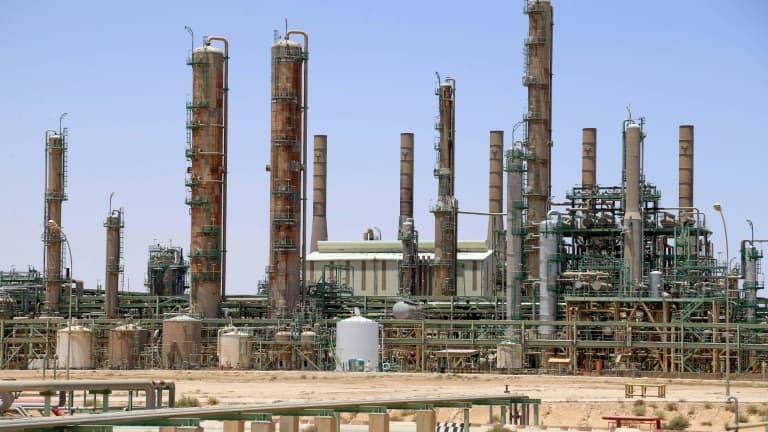
Libya's oil and gas infrastructure includes fields, refineries and pipelines. The country is divided into six main sedimentary basins: Sirte, Ghadames, Murzuq, Offshore/Tripolitania and Cyrenaica. Most of the country's oil production capacity is concentrated in the onshore Sirte Basin in the northeast and the Murzuq Basin in the southwest.
Key fields include Sarir (discovered in 1961), Messla (discovered in 1971) , Hofra (discovered in 1958) , Sharara , Waha , Bouri, Bahr Essalam, Sabratha and Al Jurf (offshore fields). The Western Libya Gas Project (WLGP) is a 50/50 joint venture between NOC and Eni, operational since October 2004.
The geographic concentration of production in a few key basins means that conflicts or disruptions in these specific regions can have a disproportionate impact on national output. For example, the shutdown of the Sharara oil field in early August 2024 severely disrupted crude oil production. Although Libya has vast reserves, the concentration of active production in a few key basins makes the entire sector highly vulnerable to localized security incidents or political disputes. This highlights a systemic risk that cannot be fully mitigated by simply increasing overall investment; targeted improvements in security and governance in these specific areas are paramount for stable production.
B. Condition of Refineries and Pipelines: Damage and Repair Efforts
A large part of Libya's energy infrastructure has been neglected and damaged by more than a decade of conflict. This degradation affects production sustainability and project timelines.
Libya is a net importer of petroleum products because of its low operational refining capacity. Its refineries operate at only 90,000 barrels/day, which indicates underperformance. Ras Lanuf, Libya's largest refinery in terms of nameplate capacity, was severely damaged after the 2011 civil war and has been out of service since 2013. A legal dispute over the damage between the joint venture (JV) owners, NOC and Trasta, was settled in February 2022, allowing NOC to acquire Trasta's 50% stake.
Regarding pipelines, the Arabian Gulf Oil Company (AGOCO) successfully completed emergency maintenance on a crude oil pipeline near kilometer point 76 between Hamada and Zawiya in July 2025, following a leak. This repair used a composite bonding technique rather than traditional welding to avoid technical risks, demonstrating the Libyan national oil sector's ability to handle challenges independently. However, the overall need for infrastructure modernization (aging pipelines and ports) is estimated at $30 billion.
The degradation and underperformance of Libya's downstream (refineries) and midstream (pipelines, terminals) infrastructure constitute a major bottleneck, preventing the country from fully capitalizing on its upstream potential. This situation forces Libya to import refined products even with its own crude resources, and it exacerbates fuel smuggling problems. The need for $30 billion in infrastructure investment heightens this issue. The scale of infrastructure degradation is a critical long-term challenge that requires massive, sustained investment beyond annual maintenance budgets. Without addressing it, even if political stability improves, the physical capacity to sustain high production levels or to process crude domestically will remain limited. This backlog also increases operational risks and costs, making investments less attractive.
C. Key Players: The National Oil Corporation (NOC) and International Companies
The National Oil Corporation (NOC) is the national oil company, founded in 1970, which dominates the Libyan oil industry. It is led by Farhat Bengdara (appointed in July 2022). NOC has numerous subsidiaries, including Zawia Refining, RASCO, Brega and AGOCO. It manages a network of oil, gas and product pipelines, crude oil export facilities and gas pipelines.
Libya has attracted hydrocarbon exploration since 1956. Major global companies are showing renewed interest and are competing for contracts. Majors such as BP and Shell have signed memoranda of understanding (MoUs) with NOC to assess redevelopment opportunities. BP is studying the mature giant oil fields of Sarir and Messla in the Sirte Basin, including the exploration potential of adjacent areas, and plans to reopen its Tripoli office by the end of 2025. Shell is evaluating the Atshan field. Other active international oil companies (IOCs) include Italy's Eni (which acquired 42.5% of BP's EPSA in 2022 and resumed exploration in 2023), Austria's OMV, Spain's Repsol , TotalEnergies, Chevron and Exxon Mobil. Mellitah Oil and Gas is a joint venture between NOC and Eni, operating offshore fields such as Bahr Essalam and Bouri.
NOC plays a critical but precarious role. It is the main driver of the sector's revitalization and of attracting foreign investment, but it operates in a highly fragmented and politically charged environment. Its autonomy is tested by militia control over infrastructure and by external actors. Its ability to navigate internal power struggles and external influences will be crucial to the success of any new partnership and to achieving production targets. The return of the major international oil companies (BP, Shell, Eni, etc.) signals a certain degree of confidence in NOC's efforts and in Libya's long-term potential, but these companies are also aware of the high risks involved.
III. Economic Impact and Dependence on Hydrocarbons
A. Contribution to GDP and Government Revenue
The Libyan economy depends heavily on revenues generated by exports of crude oil and natural gas. In 2021, oil revenues alone accounted for approximately 98% of total government revenue. In 2020, combined oil and natural gas export revenues made up about 73% of Libya's total export value. Primary energy production in 2022 amounted to 2.7 quads, with oil and other liquids accounting for 83.8% and natural gas for 16.2%.
This extreme dependence means that any disruption in oil production or any fluctuation in global oil prices has an immediate and severe impact on the national budget and the overall economy. The World Bank noted that the economy contracted by 0.6% in 2024, mainly due to a 6% decline in oil GDP. The Libyan economy suffers from hyper-dependence on hydrocarbons, making it highly vulnerable to external price shocks and internal production disruptions. This creates a vicious circle in which instability affects oil revenues, which in turn limits the government's ability to invest in diversification or infrastructure, thereby perpetuating dependence. This underscores the urgent need for economic diversification, as the World Bank emphasizes.
B. Fiscal and Budgetary Challenges Linked to Oil Prices
The fiscal balance is expected to shift from a surplus of 0.2% of GDP in 2024 to a deficit of 3.6% in 2025, mainly due to lower oil prices. The current account deficit is expected to narrow only slightly, from 5.0% of GDP in 2024 to 4.3% in 2025.
Energy subsidies represent a significant burden, accounting for one-third of revenues and 20% of GDP in 2024 (after adjusting to include crude oil swaps). Fuel imports jumped from an average of $3 billion (2016-2019) to $9 billion in 2024. Electricity subsidies are also substantial, with tariffs among the lowest in the world, at $0.008 per kWh.
The subsidy regime, although politically sensitive to reform, represents a major burden on Libya's public finances and a primary catalyst for illicit activities such as fuel smuggling. It is a significant structural economic challenge that undermines the potential benefits of oil revenues and contributes to budget deficits even when production recovers. Reforming these subsidies is essential for fiscal health and for fighting corruption, but it poses a considerable political challenge given its social implications.
The following table illustrates the contribution of hydrocarbons to the Libyan economy and the associated fiscal challenges.
Table 3: Contribution of Hydrocarbons to the Libyan Economy (Revenue, GDP)
| Economic Indicator | Value / Percentage | Year | Source |
|---|---|---|---|
| Government revenue from oil | 98% (estimate) | 2021 | |
| Total export value (oil and gas) | 73% (estimate) | 2020 | |
| Primary energy production (Oil) | 83.8% | 2022 | |
| Primary energy production (Natural Gas) | 16.2% | 2022 | |
| GDP growth (contraction) | -0.6% | 2024 | |
| Decline in oil GDP | -6% | 2024 | |
| Non-oil GDP growth | +7.5% | 2024 | |
| GDP growth forecast | +12.3% | 2025 | |
| Fiscal balance (surplus) | +0.2% of GDP | 2024 | |
| Fiscal balance (projected deficit) | -3.6% of GDP | 2025 | |
| Current account deficit | 5.0% of GDP | 2024 | |
| Current account deficit (projected) | 4.3% of GDP | 2025 | |
| Total cost of energy subsidies | USD 17 billion (35% of GDP) | 2024 |
IV. Major Challenges Facing the Sector
A. Political Instability and Internal Conflicts: Impact on Production and Investment
Political instability and militia attacks on hydrocarbon infrastructure have limited investment and hindered exploration and development since 2011. Libya is split between two rival governments in the east and west that frequently contest control of under-invested oil resources.
Crude oil production is highly volatile and frequently interrupted by conflicts, social disputes, budget constraints, maintenance problems and insufficient storage capacity. Militias have used oil exports as leverage, causing massive production disruptions between 2014 and 2020. Recent examples include the shutdown of the large Sharara oil field in early August 2024, and disruptions at eastern oil fields in late August 2024 following a dispute over the leadership of the Central Bank of Libya, causing production to drop below 600,000 barrels/day. A shutdown in 2024 led to the loss of 700,000 barrels/day, affecting offshore fields such as Al Jurf.
Political instability, fragmented governance and security threats near key oil terminals and pipelines remain major concerns for investors. New clashes or a collapse of the Government of National Unity (GNU) could trigger force majeure declarations, halting production.
Political instability is not merely an external factor but the fundamental obstacle to realizing Libya's full energy potential. It translates directly into operational volatility, financial losses and a high-risk environment that discourages sustained, large-scale investment. Any economic recovery or growth in the sector depends directly on establishing lasting political consensus and improving governance, as the World Bank emphasizes.
B. Infrastructure Degradation and Maintenance Needs
Years of conflict have led to infrastructure degradation, affecting production sustainability and project timelines. Refineries have low utilization rates because some facilities were damaged during the civil war and progress in rehabilitating all plants has been slow. Ras Lanuf, the largest refinery, has been out of service since 2013.
NOC's 2025 investment plan prioritizes offshore infrastructure and interventions, with a budget of $3 to $4 billion to meet its production targets. However, the overall modernization need (aging pipelines and ports) is estimated at $30 billion. The extent of the infrastructure damage is not simply a matter of isolated incidents but the cumulative effect of more than a decade of conflict and underinvestment. This has led to a significant maintenance backlog and deterioration, requiring a massive injection of capital. The continuing need for "well interventions" and the offline status of major facilities such as the Ras Lanuf refinery are examples. Without addressing it, even if political stability improves, the physical capacity to sustain high production levels or to process crude domestically will remain limited. This backlog also increases operational risks and costs, making investments less attractive.
C. Illicit Activities: The Scourge of Fuel Smuggling
Fuel smuggling is a major problem, costing Libya more than $700 million a year and generating annual revenues of around $3 billion for the main beneficiaries. The illicit exploitation of Libyan oil undermines Libya's sovereignty, fuels the black market and contributes to greater instability in the region. It is condemned by United Nations Security Council resolutions (UNSCR).
High subsidies on petroleum products (sold for as little as 2-3 US cents per liter) increase demand and encourage smuggling. Smuggling networks have thrived amid political turmoil and armed conflict, infiltrating not only militias but also fuel distribution companies. Fuel smuggling is not just an economic crime but a significant destabilizing force, directly financing armed groups and corrupting state institutions. It represents a critical governance challenge that undermines state control over its main resource and diverts substantial revenues. Addressing it requires not only law enforcement efforts but also fundamental reforms of the subsidy system, which is politically complex but essential for long-term stability and economic integrity.
D. Regulatory Framework and Investment Risks
Legal ambiguities and delays in contract approvals pose regulatory risks for foreign operators. NOC's 2025 bid round revised the production sharing agreements (PSAs) to increase returns to an internal rate of return (IRR) of 35.8%, among the highest in the industry, in order to attract the majors.
Libya's energy sector presents a classic high-risk, high-reward scenario. Although the potential returns are exceptionally attractive, they are directly correlated with severe political and operational risks. International companies are returning, but their success will depend on their ability to manage these complex challenges, which implies that only those with significant risk-mitigation expertise and a long-term strategic vision are likely to succeed.
V. Investment Opportunities and Outlook
A. Untapped Potential and Exploration Blocks
Libya has vast untapped potential for oil and gas exploration and development. Most of Libyan territory remains unexplored for oil. Key areas of interest include the Sirte, Murzuq and Ghadames basins, which remain rich in untapped hydrocarbon potential. Offshore fields, like the Ghadames Basin, could reveal high-impact discoveries.
In January 2025, NOC launched its first exploration bid round in 17 years, offering 22 onshore and offshore blocks, including areas in the offshore Sirte Basin. This initiative, which has drawn interest from companies such as Repsol and BP, signals future offshore development. These blocks could hold 1.63 billion barrels of oil equivalent. The untapped potential represents a significant opportunity for companies seeking large-scale, low-cost discoveries in a mature hydrocarbon province. It is a major draw for international oil companies, especially as global exploration opportunities become scarcer. However, realizing this potential requires sustained investment and a stable operating environment, making it a long-term bet on Libya's political trajectory.
B. Return of the International Majors and New Partnerships
International oil companies (IOCs) are accelerating their return to Libya, reversing the withdrawal that followed the 2011 revolution and the subsequent civil unrest. Shell and BP have signed new agreements/MoUs with NOC to explore and develop oil and gas fields and to study potential opportunities. BP aims to assess redevelopment opportunities in the mature giant oil fields of Sarir and Messla in the Sirte Basin, including the exploration potential of adjacent areas, and plans to reopen its Tripoli office by the end of 2025. Shell is evaluating the Atshan field.
Other global players such as Eni, OMV and Repsol are also active in Libya again. Chevron and TotalEnergies are competing in Libya's first energy exploration bid round since 2011. The return of large international oil companies such as BP, Shell, Eni, Chevron and TotalEnergies is a significant development. It is driven by Libya's vast reserves, low extraction costs and potentially high returns , as well as a strategic pivot by some majors toward fossil fuels after less profitable renewable ventures. These partnerships are crucial for bringing the capital, technology and expertise needed to modernize infrastructure, rehabilitate fields and increase production. Their presence also lends credibility and potentially stability to the sector, although their long-term commitment will depend on tangible improvements in the operating environment.
C. NOC's Strategic Plans and Future Projects
NOC has drawn up ambitious plans in partnership with major international companies aimed at boosting production, modernizing infrastructure and expanding Libya's presence in global energy markets. NOC is fully open to partnerships in all areas of the energy sector, including petrochemicals (such as fertilizers, methanol and ethylene) and oil refining projects, designed to meet domestic energy needs and export surpluses.
Key gas projects include the resumption in February of gas production at well CC18 in the offshore Bahr Essalam field, operated by Mellitah Oil and Gas. The Sabratha compression project, in the execution phase with a start-up planned for late 2025, aims to improve gas production. The Bouri gas utilization project focuses on increasing gas output from the Bouri field. Eni's Structures A&E project, with drilling planned for mid-2025, will route gas from two offshore fields to Mellitah. NOC's ambitious production target is to reach 2 million barrels/day by 2028.
NOC's overall strategic vision is commendable and necessary for Libya to maximize the value of its hydrocarbon resources. However, achieving these ambitious goals depends heavily on overcoming the persistent challenges of political instability, infrastructure degradation and illicit activities. The success of these plans will require not only foreign investment but also significant internal reforms and a unified national strategy.
D. Upstream Market Growth Potential
Libya's upstream oil and gas market is expected to grow at a compound annual growth rate (CAGR) of 5.5% over the 2026 to 2032 forecast period. Growth drivers include technological advances, rising demand and regulatory support. The sector offers high-margin upstream investment opportunities thanks to low lifting costs, prolific reservoirs and under-explored basins. NOC encourages risk-sharing contracts, enhanced oil recovery (EOR) methods and technology-based seismic surveys.
The Libyan upstream sector represents an attractive investment proposition for companies willing to manage geopolitical risks. The combination of vast untapped reserves, low production costs and a strategic location offers a significant competitive advantage. This implies that if stability can be maintained, the sector is on track for substantial growth, making it a crucial area for future energy supply.
VI. Long-Term Outlook and Future Scenarios
A. Oil and Gas Production Projections (2025-2030 and Beyond)
In the short term (2025), oil production is expected to average 1.3 million barrels per day, exceeding its ten-year historical average and marking a 17.4% increase over 2024. This rebound in oil production is expected to accelerate Libya's GDP growth to 8.4% in 2025.
In the medium term (2026-2032), Libya's upstream oil and gas market is expected to grow at a CAGR of 5.5%. NOC's ambitious goal is to reach 2 million barrels/day by 2028. However, projections indicate further substantial declines in natural gas production by 2025, particularly affecting the Wafa and Bouri fields.
There are clearly optimistic prospects for oil production growth in the short and medium term. This growth is expected to boost the overall economy. However, a contrasting trend is the projected decline in natural gas production by 2025. While oil production is poised for a significant rebound, the decline in natural gas output presents a potential long-term challenge, particularly given its critical role in domestic power generation. This divergence suggests that, while Libya can strengthen its position as an oil exporter, it may face growing domestic energy security problems related to gas, or may need to reassess its energy mix. It could also affect its ability to export gas to Europe, a strategic market.
The following table presents Libya's oil production projections.
Table 4: Oil Production Projections for Libya (2024-2028)
| Period | Target / Projected Production (Barrels per Day) | Notes |
|---|---|---|
| Dec 2024 | 1,260,000 | Actual production |
| Jan 2025 | 1,277,000 | Actual production |
| Projected 2025 average | 1,300,000 | +17.4% vs. 2024 |
| End-2025 target | 1,600,000 | National ambition |
| 2028 target | 2,000,000 | NOC's ambitious goal |
| Upstream market CAGR (2026-2032) | 5.5% | Projected growth |
B. Libya's Positioning against OPEC and IEA Forecasts
In the global context, world oil demand growth is expected to accelerate, from 840 kb/d in 2024 to 1.1 mb/d in 2025 (IEA). Global oil supply is expected to increase by 630 kb/d this year and by 1.9 mb/d in 2025 (IEA).
OPEC and IEA forecasts diverge significantly. OPEC expects global oil demand to rise by about 19% from current levels to reach 123 million barrels/day by 2050, asserting that "there is no peak oil demand on the horizon". By contrast, the IEA anticipates demand plateauing at around 105.5 million barrels/day by 2030 before declining.
Libya is exempt from OPEC+ production targets , which allows it to increase output. OPEC+ decisions to delay the unwinding of voluntary cuts create a potential for oversupply, but robust non-OPEC+ supply growth and relatively modest global oil demand growth suggest a comfortably supplied market in 2025.
Libya's exemption from OPEC+ cuts means that its production trajectory is largely independent of OPEC's collective decisions. Its potential for significant output increases could become a critical factor in global supply, particularly if OPEC+ cuts are lifted or if supply shortfalls elsewhere need to be offset. Libya holds a unique position as a potential "swing" producer outside the direct influence of OPEC+ quotas. Its ability to raise production could provide a crucial buffer in a volatile global market, making its stability and investment climate of paramount interest to major energy consumers and international bodies such as the IEA. Its strategic importance extends beyond its reserves to its potential to influence global supply balances.
C. Key Success Factors and Persistent Risks
Key success factors for Libya include renewed international interest, increased public-sector spending , improved exploration and production licensing rounds, rehabilitation of existing fields, the return of international oil companies (IOCs), government reforms, improved fiscal terms and strategic partnerships. Reaching a political consensus on transparent and efficient management of oil wealth would contribute significantly to further stabilizing the country.
However, persistent risks remain: political instability, fragmented governance and security threats near key oil terminals and pipelines , infrastructure degradation , legal ambiguities and delays in contract approvals , dependence on oil revenues, which exposes the market to global crude price volatility , and external influence (for example, Russia's Wagner Group and Turkey's TPAO continue to exploit factional divisions). The frozen assets of the Libyan Investment Authority (LIA), amounting to $70 billion, limit the government's ability to fund infrastructure improvements.
The many risks identified, such as political instability, infrastructure degradation, illicit activities and regulatory obstacles, are not isolated but interconnected. For example, political instability leads to infrastructure neglect and fosters illicit activities, which in turn undermine governance and discourage investment. The frozen LIA assets exacerbate infrastructure problems, creating a complex web of challenges. Libya's path to sustained energy-sector growth is not linear but depends on simultaneously resolving a complex set of interconnected risks. A holistic approach that tackles political reconciliation, governance reform, infrastructure rehabilitation and the fight against illicit activities is essential. The success of foreign investment depends on the government's ability to create a truly stable and transparent operating environment, turning today's high-risk, high-reward proposition into a more sustainable investment climate.
Conclusion
The analysis of Libya's oil and gas situation reveals a central paradox: immense hydrocarbon potential, constantly undermined by deep political instability, advanced infrastructure degradation and a prevalence of smuggling and illicit activities. Despite these structural challenges, the sector shows signs of recovery, with volatile but rising production and renewed interest from major international oil companies.
The National Oil Corporation (NOC) plays a crucial role in revitalization efforts and in attracting foreign investment. However, the Libyan economy remains hyper-dependent on hydrocarbons, making it extremely vulnerable to price shocks and production interruptions, and costly subsidies exacerbate fiscal pressure and fuel corruption.
To turn this potential into sustainable, stable growth, several strategic recommendations stand out:
- Prioritize political reconciliation and unified governance: Establishing a stable, unified governance structure is the fundamental prerequisite for ensuring consistent production and attracting long-term investment. Without a solid political framework, development efforts will remain fragmented and vulnerable.
- Reform energy subsidies: A comprehensive reform of the subsidy system is imperative to combat smuggling, improve the country's fiscal health and redirect funds toward crucial investments in infrastructure and economic diversification.
- Accelerate infrastructure rehabilitation: Massive, sustained efforts are needed to modernize and repair aging and damaged infrastructure. This could involve new international partnerships and, if possible, the use of Libya's currently frozen assets to fund these essential projects.
- Strengthen security: Enhanced security measures around oil fields, pipelines and export terminals are indispensable to minimize disruptions, protect assets and reassure investors.
- Continue to foster strategic partnerships: NOC must maintain and expand its partnerships with international oil companies, ensuring a clear and predictable regulatory environment to unlock the country's untapped potential.
- Pursue economic diversification: In the long term, Libya must commit seriously to diversifying its economy to reduce its overwhelming dependence on oil and gas revenues, in order to build a more resilient economy and create opportunities beyond the hydrocarbon sector.
Libya stands at a crossroads: its energy and economic future will depend on its ability to overcome the complex challenges that have hindered its development for more than a decade. A holistic approach, combining political, economic and security reforms, is essential for the country to fully harness its vast hydrocarbon wealth and ensure a more stable and prosperous future for its people.Sources used in the report


 Sudan
 Uganda