Oil and Gas in Uganda: Current Status and Outlook
An overview of Uganda's emergence as a hydrocarbon producer: reserves, Tilenga, Kingfisher, EACOP and the Hoima refinery, regulation, economic impact and controversies.
 By the editorial teamPetrole.Africa
I. Introduction
This section lays the groundwork for Uganda's engagement in the hydrocarbons sector, highlighting its strategic importance for national development.
Overview of Uganda's Emergence as a Hydrocarbon-Producing Nation
Uganda's transformation into a potential oil-producing nation began with the discovery of commercial oil in the Albertine Graben region in 2006. This pivotal moment marked a significant shift in the country's economic outlook. Following these discoveries, Uganda's proven crude oil reserves rose rapidly, from zero in 2010 to approximately 2.5 billion barrels at the end of 2015, according to the Oil & Gas Journal. Ugandan government estimates put total oil in place at 6.5 billion barrels in the Albertine Graben.
Of these substantial reserves, approximately 1.4 billion to 1.7 billion barrels are considered economically recoverable. This indicates a significant, though partial, base of extractable resources. While commercial oil production was initially planned as early as 2020 , current projections indicate that first oil is now expected in 2026.
Strategic Importance of the Oil and Gas Sector for Uganda's Development
The Ugandan government has made the strategic decision to harness its oil resources to drive national development and reduce poverty. This underscores a strong political will to monetize these assets. The country's oil and gas assets as a whole are valued at an impressive $116 billion gross, highlighting their immense potential contribution to the national economy.
The sector is poised to attract substantial foreign direct investment (FDI), with investments expected to range from $15 billion to $20 billion over a period of 3 to 5 years, which could effectively triple Uganda's FDI during this critical phase. Beyond direct revenues, the oil and gas industry is seen as crucial for stimulating related sectors, including infrastructure development, processing and manufacturing. This is expected to reduce Uganda's dependence on energy imports and foster broader economic growth through exports. President Yoweri Kaguta Museveni has expressed a vision of using oil revenues to build "sustainable capacity" within the nation, specifically mentioning the modernization of railways, energy infrastructure and transport networks.
Strategic Observations
The extended gap between the initial discovery of commercial oil in Uganda in 2006 and the current projection of first production in 2026 is a notable feature. This period of more than two decades, from confirmation of reserves to actual production, highlights the challenges inherent in developing a nascent oil sector in a developing country. Executing megaprojects in such a context is often hampered by considerable technical, financial, regulatory and logistical obstacles. Repeated adjustments to the "first oil" date indicate that initially optimistic forecasts often give way to the complex realities of implementation, including securing financing, navigating complex regulatory approvals and building extensive infrastructure from scratch. This situation is indicative of a broader pattern in large-scale resource development, where project delays are frequent, directly affecting economic forecasts and national development plans.
Uganda's strategic decision to exploit its oil resources is explicitly linked to national development and poverty reduction, with President Museveni stressing the use of oil funds for "sustainable capacity" in infrastructure and other sectors. This reflects a clear national ambition to leverage natural wealth for the benefit of society. However, the research materials also implicitly raise the specter of the "resource curse" by citing Nigeria as an example where oil wealth led to "widespread corruption and, consequently, even more poverty" and to "environmental degradation". This juxtaposition highlights a crucial policy dilemma for Uganda: how to manage the influx of oil revenues effectively and avoid the pitfalls of corruption, economic distortion and social inequality that have plagued other resource-rich nations. World Bank advice on "prudent macroeconomic management" and strengthening the "non-oil economy" further underscores this challenge. The success of Uganda's oil venture will be measured not only by the barrels produced or the revenues generated, but by its ability to translate this wealth into sustainable, inclusive and diversified economic growth, mitigating the risks of an "enclave economy".
II. Resource Base and Production Status
This section provides a detailed overview of Uganda's hydrocarbon reserves and the current state of its production capacity.
Proven Oil and Gas Reserves
Total oil in place in Uganda, in the Albertine Graben region, is consistently estimated at 6.5 billion barrels. This figure represents the total volume of oil identified in the reservoirs. The quantity of economically recoverable oil is a more critical metric for commercial viability. Estimates for recoverable oil range from 1.4 billion barrels to 1.7 billion barrels , with some older sources citing 2.5 billion barrels at the end of 2015. The most recent and most frequently cited figures fall in the range of 1.4 to 1.7 billion barrels, indicating a significant, though finite, extractable resource. As for natural gas, proven reserves were estimated at 500 billion cubic feet at the end of 2015 , which is approximately equivalent to 14.16 billion cubic meters (Gm³). A more recent figure also indicates 14.2 Gm³ , which shows consistency in gas reserve estimates.
Current Production Levels and First Oil Projections
Despite the substantial discoveries made more than ten years ago, Uganda does not currently produce hydrocarbons for commercial purposes. The sector is in a pre-production development phase. The long-awaited first oil is now expected to begin in 2026. This date has been adjusted before, reflecting the complexities of project execution.
Production is expected to rise considerably over the following years: initial production of 21,000 barrels per day (b/d) is planned for 2026, rising to 145,000 b/d in 2027 and peaking at 219,000 b/d by 2029. Another source indicates expected future oil production of 240,000 b/d. As of March 2025, TotalEnergies EP Uganda had already drilled more than 110 wells, with a target of 150 wells to be completed to reach first oil production.
Table: Proven Oil and Gas Reserves in Uganda
| Reserve Category | Estimated Volume | Source |
|---|---|---|
| Total oil in place | 6.5 billion barrels | |
| Economically recoverable oil | 1.4 - 1.7 billion barrels | |
| Proven natural gas reserves | 500 billion cubic feet / 14.2 Gm³ |
Strategic Observations
Although Uganda has 6.5 billion barrels of oil in place , the "economically recoverable" oil figure is significantly lower, between 1.4 and 1.7 billion barrels. An older source also mentions 2.5 billion barrels in 2015. This discrepancy and the relatively low recovery factor (20-26% of oil in place) are of critical importance. They mean that a substantial portion of the discovered oil may not be commercially viable to extract given current technologies and market conditions. This reality has direct financial implications: it limits revenue potential for the government and profitability for investors. The fluctuation in recoverable reserve estimates over time (for example, 2.5 billion in 2015 versus 1.4-1.7 billion more recently) also suggests that these figures are dynamic, influenced by changing oil prices, technological advances and operating costs. For long-term planning, this calls for a cautious approach to revenue forecasting and a focus on cost-effective extraction methods.
Uganda does not currently produce any hydrocarbons , yet it has ambitious targets of reaching 219,000 b/d by 2029. This represents a considerable leap from a non-producing state to a significant regional player in a short time. This "greenfield" (new project) development status presents unique challenges. It is not only about extracting oil, but about simultaneously building a complete integrated industry, including complex upstream production facilities, midstream pipelines and downstream refining capacity. This requires substantial capital investment, the transfer of advanced technical expertise and the development of a skilled local workforce. The gap between today's zero production and the high future targets underscores the significant execution risk and the sector's sensitivity to any delay in infrastructure development, regulatory approvals or financing. This implies that the success of Uganda's oil sector depends heavily on the synchronized and efficient progress of all major projects.
III. Historical Development and Key Milestones
This section traces the historical trajectory of Uganda's oil and gas sector, from the first discoveries to the critical investment decisions of recent years.
Early Discoveries and Colonial-Era Exploration
The presence of oil in Uganda dates back to the late 19th century, when local communities discovered oil seeps in the Albertine region. These discoveries were formally documented by the explorers Emin Pasha in 1877 and F. Lugard in 1890. The first official confirmation of hydrocarbons came from a geological survey conducted by the British colonial administration in 1925, detailed in the publication "Petroleum in Uganda" by E.J. Wayland. This report sparked initial international interest. Between 1936 and 1956, the African-European Investment Company drilled shallow stratigraphic wells, and the first deep well at Butiaba in 1938 encountered bitumen. However, exploration efforts during this period were sporadic and considerably hampered by major geopolitical events such as the Second World War and a shift in colonial policy that designated East Africa primarily as an agricultural zone. As a result, no commercially viable reserves were discovered before Uganda's independence.
Post-Independence Exploration and Legislative Foundations
After independence, political unrest and insecurity largely held back exploration activities until the early 1980s, when President Obote returned to power. Modern exploration efforts resumed in 1983 with the acquisition of 9,578 km of aeromagnetic data, which successfully identified three depositional centers along the Albertine Graben. Crucially, the government began laying the legislative and administrative groundwork, enacting the Petroleum (Exploration and Production) Act in 1985 and establishing a dedicated petroleum unit within the Department of Geological Survey and Mines. This Act, together with the Petroleum (Exploration and Production) (Conduct of Exploration Operations) Regulations of 1993, provided the initial framework for upstream activities.
An important milestone was the start of specialized training of Ugandan professionals in petroleum matters in 1986, with staff sent to Norway, the United States and India to strengthen their bargaining power in future negotiations. The first production sharing agreements (PSAs) were signed with Petrofina (1991) and the Uganda Works and General Engineering Company (1995), although these were subsequently cancelled due to an alleged breach of the agreed terms. In 1997, Heritage Oil and Gas signed an agreement for Exploration Area (EA) 3A, carrying out the first seismic surveys, which considerably boosted confidence in the presence of substantial oil deposits.
Major Discoveries and Final Investment Decisions (FID)
The 2000s marked a period of intensified exploration, driven by rising oil prices and a decade of political stability. Ireland's Tullow Oil became a dominant player, alongside Hardman Resources and Heritage Oil, making significant discoveries. Commercial thresholds for oil extraction were reached in 2006 for EA2, in 2007 for EA3A and in 2009 for EA1. Through strategic acquisitions, Tullow Oil consolidated rights to all exploration areas with significant discoveries (EA1, EA2 and EA3A), and drew oil giants Total and CNOOC into an equal-share joint venture in 2011.
The National Oil and Gas Policy was approved in 2007/2008 , providing comprehensive strategic direction for the sector. Further legislative developments in 2013 saw the enactment of the Petroleum (Exploration, Development and Production) Act and the Petroleum (Refining, Conversion, Transmission and Midstream Storage) Act, which formally established the Petroleum Authority of Uganda (PAU) and the Uganda National Oil Company (UNOC). Uganda held its first competitive licensing round for 6 blocks in the Albertine Graben in 2015, which led to licenses being awarded to Armour Energy Limited (Australia) and Oranto Petroleum Limited (Nigeria).
A critical milestone was reached in February 2022, when TotalEnergies EP Uganda, CNOOC Uganda Limited, UNOC and the Tanzania Petroleum Development Corporation (TPDC) announced the Final Investment Decision (FID) for the upstream oil production projects (Tilenga and Kingfisher) and the East African Crude Oil Pipeline (EACOP). This decision formally launched the detailed engineering, procurement and construction (EPC) phase of these major projects. The FID was preceded by key agreements, including the Intergovernmental Agreement (IGA) between Uganda and Tanzania in May 2017, which laid the foundation for the pipeline project, and the Host Government Agreements (HGAs) signed in April and May 2021, establishing the legal and commercial framework for the EACOP.
Strategic Observations
The historical timeline clearly illustrates a causal link between political stability and the progress of Uganda's oil sector. Early exploration was "erratic and hampered by geopolitical events" and by "post-independence political uncertainty and instability". Significant, sustained efforts began only in the early 1980s, and above all, the "decade of stability" in the 2000s directly led to a "significant increase in investment" and growing interest from international companies. This demonstrates that for large-scale, capital-intensive, long-term projects such as oil and gas development, a stable political environment is a fundamental prerequisite for attracting and retaining foreign investment. Instability creates perceived risk, deterring the capital and expertise needed. The NRM government's deliberate strategy of building local capacity also reflects a long-term vision made possible by this stability.
Uganda's legislative journey, from the initial 1985 Petroleum Act to the more comprehensive 2013 petroleum laws and the creation of dedicated institutions such as the PAU and UNOC , reveals a deliberate, evolving strategy. The 1995 Constitution's affirmation of State ownership of natural resources and the subsequent training of Ugandan professionals indicate a conscious effort to strengthen the State's bargaining power and control over its resources. This progression signifies a shift from simply attracting foreign companies to actively managing and maximizing the sector's national benefits. It suggests a learning curve in resource governance, in which the State has gradually strengthened its capacity to regulate, to participate commercially and to ensure its "permanent sovereignty" over these strategic assets. This evolution is crucial for the sector's long-term stability and investor confidence, as it provides a clearer, though still developing, operating framework.
IV. Major Projects and Infrastructure Development
This section details the flagship projects currently under way in Uganda's oil and gas sector, covering upstream production, midstream transport and downstream refining capacity.
Upstream Projects
Uganda's upstream sector is dominated by two major projects: Tilenga and Kingfisher.
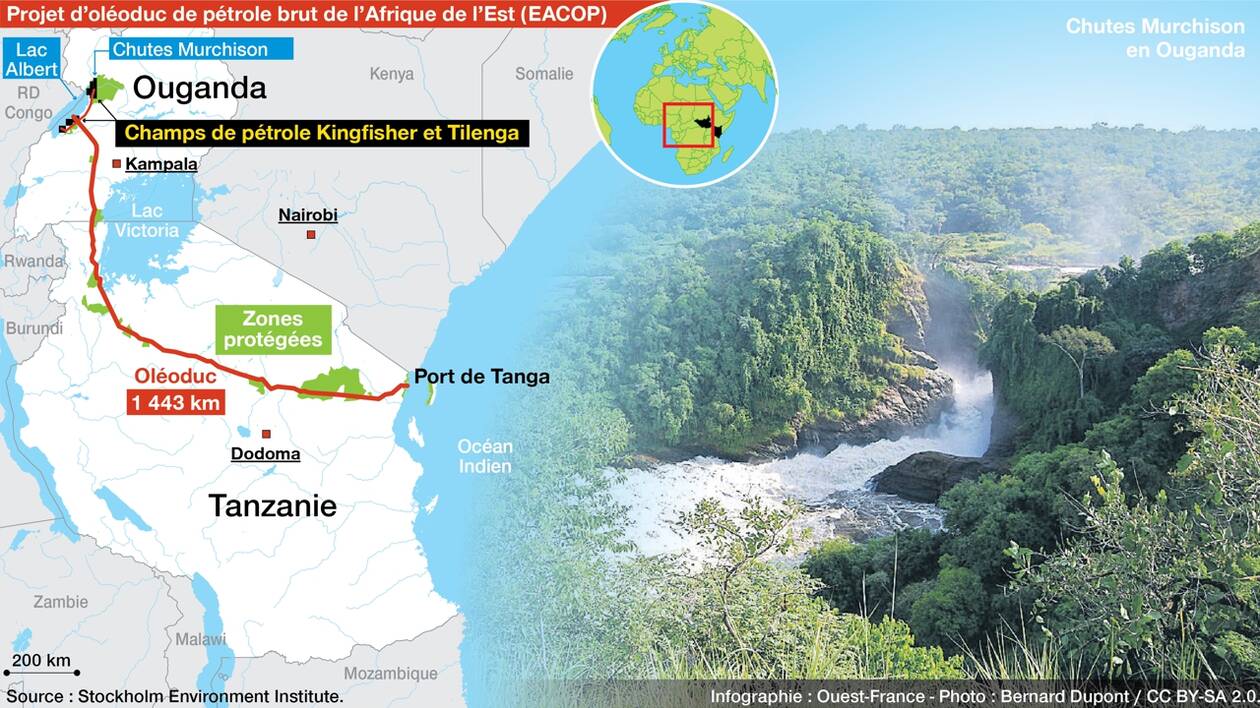
The Tilenga Project is operated mainly by TotalEnergies (56.6%), in partnership with the China National Offshore Oil Corporation (CNOOC) and the Uganda National Oil Company (UNOC). At start-up, Tilenga is expected to produce a significant volume of up to 190,000 barrels per day (b/d). Combined with the Kingfisher project, initial production is projected at 21,000 b/d in 2026, rising to 145,000 b/d in 2027 and reaching 219,000 b/d by 2029. The project involves developing six fields and drilling approximately 400 to 420 wells from 29 separate well pads. The extracted production will be transported by buried pipelines to a central processing facility (CPF) located at Kasenyi, where crude oil, water and gas will be separated and treated. The gas produced will be used for energy needs, with surplus electricity potentially exported to the EACOP pipeline and the Ugandan national grid. A notable aspect of the project is that one of the fields being developed is located in Murchison Falls National Park, while others are located south of the Victoria Nile in mainly agricultural areas. The construction phase is actively under way, encompassing the development of facilities, flowlines, roads and drilling operations. As of March 2025, more than 110 wells had already been drilled.
The Kingfisher Project is operated by the Chinese company CNOOC. This project is designed to produce up to 40,000 b/d. It involves developing the Kingfisher production license area. CNOOC obtained a production license for Kingfisher earlier than the other operators , and significant progress was reported in March 2025.
Midstream Infrastructure
Developing midstream infrastructure is essential for the transport and processing of hydrocarbons.
The East African Crude Oil Pipeline (EACOP) is a fully buried, heated pipeline of 1,443 km or 1,445 km. It will carry crude oil from Kabaale, Hoima District in Uganda, to the Chongoleani peninsula near the port of Tanga in Tanzania. It is notable as the world's longest heated pipeline, designed to keep oil from Tilenga above 50°C during transit. EACOP Ltd., the company responsible for building and operating the pipeline, is a special-purpose company in which TotalEnergies holds 62%, UNOC 15%, the Tanzania Petroleum Development Corporation (TPDC) 15% and CNOOC 8%. The Final Investment Decision (FID) for the EACOP was announced in February 2022 , marking the formal start of the project. A construction license was received in January 2023 , and as of March 2025, more than 100 km of the pipeline had already been laid. Completion is planned for 2026. The pipeline system includes six pumping stations (two in Uganda and four in Tanzania), as well as a storage terminal and a loading jetty at the port of Tanga.
The Hoima Refinery is a planned oil refinery located at Kabaale, Hoima District, designed to process 60,000 b/d of crude oil. Initial processing capacity is expected to be 30,000 b/d, rising to 60,000 b/d thereafter. The Albertine Graben Energy Consortium (AGEC), a US-led group (including Baker Hughes-General Electric, YAATRA Africa and Saipem), initially won the rights to finance, build and operate the refinery in 2018, with negotiations toward an FID ongoing. However, in a significant development in March 2025, Uganda signed an agreement with Alpha MBM Investments LLC, based in the United Arab Emirates, which will take a 60% stake in the refinery, with UNOC retaining 40%. Despite the recent agreement, lengthy negotiations and a lack of specific updates on the FID suggest that refinery operations could realistically begin by 2028. The March 2025 agreement with Alpha MBM Investments is a crucial step that paves the way for construction. The refinery project also includes a modern storage terminal at Namwabula, Mpigi District, a 212 km multiproduct pipeline linking the refinery to this terminal for efficient transport of refined products, and the Mbegu water abstraction facility to support refinery operations.
Other Potential Projects
Uganda and Tanzania have agreed to carry out a feasibility study for a gas pipeline that would link Tanzania's gas fields to Uganda. Ugandan President Museveni has expressed interest in using the EACOP corridor for natural gas imports from Tanzania.
Table: Overview of Major Oil and Gas Projects
| Project Name | Type | Operator/Lead Company | Capacity/Length | Current Status/Timeline | Key Stakeholders |
|---|---|---|---|---|---|
| Tilenga | Upstream | TotalEnergies (56.6%), CNOOC, UNOC | ~190,000 b/d | Under construction (First oil 2026) | TotalEnergies, CNOOC, UNOC |
| Kingfisher | Upstream | CNOOC | ~40,000 b/d | Under construction (First oil 2026) | CNOOC |
| EACOP Pipeline | Midstream (Pipeline) | EACOP Ltd. (TotalEnergies 62%, UNOC 15%, TPDC 15%, CNOOC 8%) | 1,443-1,445 km | Construction license received (Completion 2026) | TotalEnergies, UNOC, TPDC, CNOOC |
| Hoima Refinery | Midstream (Refinery) | Alpha MBM Investments (60%), UNOC (40%) | 60,000 b/d | Agreement signed (Operations ~2028) | Alpha MBM Investments, UNOC, AGEC (historical) |
| Tanzania-Uganda Gas Pipeline | Midstream (Feasibility Study) | Ugandan/Tanzanian governments | Feasibility study | Feasibility study agreed | Ugandan/Tanzanian governments |
Export to Sheets
Strategic Observations
The detailed project description reveals a highly integrated development strategy: upstream production from the Tilenga and Kingfisher fields is directly linked to midstream transport via the EACOP and to downstream processing at the Hoima Refinery. Oil from the fields will feed both the refinery and the export pipeline. While this integration aims at maximum value addition, energy security and export potential , it also creates significant interdependencies. This means that any substantial delay, financial obstacle or legal challenge affecting one major component (for example, the Hoima Refinery's prolonged FID or environmental opposition to the EACOP ) can create knock-on effects, compromising the overall timeline and economic viability of Uganda's entire oil sector. This highlights a strategic vulnerability: the success of the whole system depends on the synchronized and successful execution of all its interconnected parts.
The trajectory of the Hoima Refinery project, from an initial US-led consortium (AGEC) that won the development rights in 2018 to a more recent agreement with the UAE-based Alpha MBM Investments in March 2025 , is highly revealing. This shift, combined with "lengthy negotiations and a lack of updates on the final investment decision" and the difficulties reported by the Ugandan government in securing refinery financing , suggests persistent and significant financial obstacles for downstream projects. The transition from Western consortia to Middle Eastern investors may reflect a changing global investment landscape, in which traditional Western financiers are increasingly wary of fossil fuel projects because of environmental, social and governance (ESG) concerns (as shown by banks' refusal to back the EACOP ). This implies that Uganda is actively diversifying its financial partners to achieve its strategic goal of value addition through refining, but it also underscores the ongoing challenges of attracting and securing large-scale capital for such complex ventures.
V. Regulatory and Institutional Framework
This section describes the legal and governmental structures governing Uganda's oil and gas sector, highlighting the roles of key entities and oversight mechanisms.
Key Legislation
The fundamental legal authority over Uganda's natural resources, including oil and gas, is the 1995 Constitution of the Republic of Uganda. It expressly vests these resources in the State, to be held on behalf of and for the benefit of the people of Uganda. In addition, Article 244 gives the Ugandan Parliament the mandate to enact laws for the regulation and exploration of mineral and petroleum resources, as well as for the management of the resulting revenues. This establishes the principle of permanent sovereignty over natural resources.
The specific laws governing the oil and gas sector are divided to cover different segments of the petroleum value chain:
- The Petroleum (Exploration, Development and Production) Act of 2013 (P(EDP)A): This Act primarily regulates upstream activities, including exploration and production. It reinforces the constitutional principle by vesting all petroleum resources in the State. The minister responsible for energy is vested with the power to grant petroleum rights and to monitor compliance with the terms of contracts and the law. The Act strictly prohibits any petroleum activity in Uganda without proper authorization, license or approval.
- The Petroleum (Refining, Conversion, Transmission and Midstream Storage) Act of 2013: This legislation specifically governs midstream activities, encompassing refining, gas conversion, and the transportation and storage of petroleum.
Older, foundational legislation includes the Petroleum (Exploration and Production) Act of 1985 and the Petroleum (Exploration and Production) (Conduct of Exploration Operations) Regulations of 1993, which originally regulated upstream activities. The
Income Tax Act also plays a crucial role in the fiscal regime and revenue-sharing mechanisms within the sector. It is important to note that efforts are under way to draft new bills and update existing regulations. This ongoing refinement aims to address identified weaknesses and incorporate international best practices, particularly with regard to transparent land management.
Roles of the Main Government Entities
Several government entities play a central role in governing the oil and gas sector:
The Ministry of Energy and Mineral Development (MEMD): As one of Uganda's government bodies, the MEMD is responsible for developing and implementing policies relating to electricity, minerals, petroleum and petroleum products. It is part of the national cabinet and is headed by a Cabinet Minister (currently Hon. Ruth Ssentamu Nankabirwa). The Ministry's mandate extends to energy policy, investment in mining and the establishment of new power generation infrastructure using hydropower, thermal, solar, wind and even nuclear energy. Its headquarters is located at Amber House, Kampala.
The Petroleum Authority of Uganda (PAU): Established under Part III of the Petroleum (EDP) Act of 2013 , the PAU is the main regulatory body for the petroleum sector. Its primary mandate is to monitor and regulate all petroleum activities: exploration, development, production, refining, gas conversion, transportation and storage in Uganda. The PAU's mission is to create sustainable value for Ugandans and to position Uganda as a strong investment destination. It is committed to ensuring that the sector's regulatory environment supports the sustainable development of oil and gas resources while allowing competitive returns for private-sector partners. All companies wishing to participate in Uganda's petroleum sector are required to register in the PAU's National Suppliers Database.
The Uganda National Oil Company (UNOC): UNOC is a limited liability company wholly owned by the Ugandan government, established under the Petroleum (Exploration, Development and Production) Act and the Petroleum (Refining, Conversion, Transmission and Midstream Storage) Act of 2013. Its main function is to manage the Ugandan government's commercial interests in the oil and gas industry and to ensure sustainable exploitation of the resource. UNOC specifically leads upstream operations.
Licensing and Oversight Mechanisms
The minister is empowered to grant petroleum rights, including petroleum exploration licenses (allowing exploration for a maximum of 2 years, renewable twice) and petroleum production licenses (granting rights to carry out petroleum activities, sell the recovered oil and perform development works). The right to apply for a production license is reserved exclusively for exploration license holders that have made a discovery. The PAU is responsible for monitoring and regulating companies holding these licenses, ensuring compliance with contract terms and legal provisions.
Strategic Observations
Uganda's regulatory journey began with foundational laws in the 1980s and 1990s, culminating in the more comprehensive 2013 petroleum laws and the creation of specialized bodies such as the PAU and UNOC. This progression reflects a deliberate, iterative process of building a robust governance structure from scratch. The explicit mention of "ongoing efforts to draft new bills and update existing regulations to address weaknesses and incorporate international best practices" indicates that, despite its comprehensiveness, the framework is still being refined. This suggests a commitment to continuous improvement and to adapting to internal needs (for example, transparent land management) and external pressures (for example, international standards). For investors, this implies a dynamic regulatory environment that requires ongoing monitoring, but also a government that is responsive to evolving best practices.
The Ugandan State, through the PAU, is tasked with "monitoring and regulating" the petroleum sector to ensure sustainable development and competitive returns. At the same time, the Uganda National Oil Company (UNOC), an entity wholly owned by the State, is tasked with managing the "commercial interests of the Government of Uganda" and is a direct shareholder in major projects such as the EACOP. This creates an inherent dual role for the State, as both regulator and commercial participant/owner. While this structure allows the government to capture the value of its resources directly, it also raises potential questions about conflicts of interest, the impartiality of regulatory oversight and the potential for the State's commercial interests to override purely regulatory objectives. Although the excerpts provide no direct evidence of such conflicts, expert analysis must acknowledge this structural tension and its potential implications for governance, transparency and accountability within the sector.
VI. Economic Implications and Opportunities
This section examines the anticipated economic impacts of Uganda's oil and gas sector, including projected investments, government revenues, job creation and local content development.
Expected Investment and Contribution to GDP
The development of Uganda's oil and gas projects is expected to attract substantial investment, estimated at between US$15 and US$20 billion over a short period of 3 to 5 years. This significant inflow of capital is expected to be a major catalyst for economic growth. Crucially, these investments are expected to triple Uganda's foreign direct investment (FDI) over this period, underscoring the sector's immense potential to attract international capital.
The direct investment of $15 billion in the oil and gas sector is expected to drive indirect GDP growth for Uganda of nearly $9 billion. This represents a substantial contribution, equivalent to about 20% of Uganda's current GDP of $45.7 billion. The World Bank forecasts that the start of oil production will significantly boost Uganda's overall economic growth, accelerating it to 10.4% in fiscal year 2027, before it levels off at around 6% as oil production plateaus.
Projected Government Revenues (Tax and Non-Tax Benefits)
The total value of Uganda's oil and gas assets is estimated at an impressive $116 billion (gross), indicating the scale of the resource wealth. Under the agreed fiscal regime, the government is expected to receive a net share of 75% from upstream projects, which represents approximately $66 billion over the life of the projects, or an average of $2.6 billion per year. From the East African Crude Oil Pipeline (EACOP) project, the government expects to earn an additional $400 million through dividends and applicable taxes. The Hoima Refinery is also expected to contribute significantly, with the government set to earn $3.3 billion from dividends and taxes.
Cumulatively, from these three main projects (upstream, EACOP, refinery), the Ugandan government is expected to earn a total of $69.7 billion over their operating life, or an average of $2.8 billion per year. This average annual government revenue represents a substantial 47% of Uganda's projected domestic revenue for fiscal year 2022/2023 ($6 billion), underscoring the transformative potential for public finances. Beyond these major revenues, the sector has already generated non-tax revenue (NTR) of $7,662,580 between 2017 and 2021, from application fees, bonuses, data sales, surface rentals and training fees. Other tax benefits include income tax, PAYE (Pay As You Earn), stamp duty, value added tax (VAT) and withholding tax.
Job Creation (Direct, Indirect, Induced)
The oil and gas sector is a significant employer. Currently, approximately 10,111 Ugandans are estimated to be directly employed in the sector. This number is expected to reach 13,000 at peak activity. Beyond direct employment, the investments are expected to stimulate substantial indirect employment (estimated at 35,000 jobs) and induced employment (estimated at 100,000 jobs) across various sectors of the economy.
Local Content Development and Sectoral Linkages
Uganda has prioritized local content development to ensure that a significant share of the sector's economic benefits remains in the country. During the exploration phase, of the $3.5 billion spent, $980 million (28%) was retained in the Ugandan economy through the local supply of goods and services. In the ongoing development phase, more than 145 contracts, with a total value of $6.8 billion, have been awarded in the upstream and midstream segments, indicating substantial opportunities for local businesses. Leveraging the linkages between the oil and gas sector and other parts of the economy is considered crucial to achieving broad and inclusive economic development, avoiding the formation of an "enclave economy". The Hoima Refinery, in particular, is expected to be a catalyst for economic transformation, creating thousands of jobs, fostering local expertise and serving as a springboard for the development of related industries such as petrochemicals and fertilizer production.
Table: Projected Economic Benefits of Oil and Gas
| Economic Indicator | Estimated Value | Source |
|---|---|---|
| Total expected investment | US$15-20 billion | |
| Contribution to GDP (indirect) | ~US$9 billion (20% of current GDP) | |
| Total government revenue (project lifetime) | US$69.7 billion | |
| Average annual government revenue | US$2.8 billion | |
| Direct employment (current/peak) | 10,111 / 13,000 | |
| Indirect employment | 35,000 | |
| Induced employment | 100,000 | |
| Local content retention (exploration phase) | 28% (US$980 million) |
Strategic Observations
The projected economic benefits are indeed transformative: a tripling of FDI, a significant acceleration of GDP growth to more than 10% , and oil revenues that could potentially amount to nearly half of current domestic revenues. This paints a picture of immense opportunity for Uganda. However, the World Bank explicitly warns that "the pace of reforms has slowed, hindering economic growth and poverty reduction efforts in Uganda" and points to the "persistent human capital deficit and the absence of a meaningful productive job creation agenda". This implies that simply generating oil wealth is not enough; achieving broad and inclusive economic development depends on sound governance, continued structural reforms, prudent macroeconomic management and strategic investments in human capital and non-oil sectors. Without these, the risk of an "enclave economy" , where oil benefits do not spread widely, remains high. The challenge is not just to extract the oil, but to use the revenues effectively to build a resilient and diversified economy capable of sustaining growth beyond oil's finite lifespan.
Uganda displays a clear ambition on local content, aiming to retain a "significant share of investments in the form of jobs and the supply of goods and services". Although 28% of exploration spending was retained locally and direct employment figures are provided , critical reports suggest a potential gap between this ambition and reality. For example, critics claim that "most contracts for this multibillion-dollar project have gone to foreign companies", relegating local firms to a "supporting role", and that the number of permanent jobs projected would be far lower than the tens of thousands announced. This highlights the challenge of translating policy into widespread local benefit.
VII. Challenges and Controversies
This section examines the challenges and controversies surrounding Uganda's oil and gas sector, focusing on environmental and social impacts, as well as legal obstacles and political opposition.
Environmental and Social Impacts
Oil and gas projects in Uganda have drawn considerable attention because of their potential environmental and social impacts. Global critics, environmentalists and local communities have voiced concern, notably the European Parliament, which called for the EACOP to be halted.
The EACOP project (East African Crude Oil Pipeline) is particularly controversial. It poses a significant threat to ecosystems and biodiversity, crossing ecologically sensitive areas, protected areas and wildlife corridors, and endangering unique and fragile ecosystems, including the Lake Victoria basin and important wetlands. Threatened species such as elephants, lions and chimpanzees are also at risk. The risk of an oil spill is high, as the pipeline crosses the Rift Valley, one of the most seismically active regions in the world. Inadequate contingency plans and conflicting information on oil solidification, together with insufficient block valves, heighten concerns about the consequences of a leak. On the climate front, the project is expected to produce approximately 379 million tonnes of carbon dioxide emissions over 25 years , which is incompatible with the Paris Agreement's 1.5°C goal. Allegations that Total has underestimated greenhouse gas emissions have also been raised.
The projects require land acquisition of approximately 6,400 hectares, affecting 19,162 households and resulting in the relocation of 775 primary residences. Allegations of inadequate compensation, coercion, lack of choice, payment delays, land-use restrictions and loss of livelihoods have been documented. Environmental defenders have reported harassment, arrests and threats , as well as allegations of physical and legal threats, lack of transparency and violations of freedom of expression.
The Tilenga Project also faces controversy. Although its permanent footprint in Murchison Falls National Park is limited to less than 0.03% of the park's area , allegations have been made of insufficient environmental protection measures, compromised audit firms and "greenwashing". The impact on wildlife is a concern, with disturbances to elephants (resulting in crop destruction and human deaths), light pollution affecting nocturnal predators, and offset measures for chimpanzees judged to be unambitious. The need for physical barriers and daily rescues of trapped animals underscores the challenges. Human rights defenders in the Albertine region have been victims of attacks, torture, unlawful arrests and physical violence.
The Kingfisher Project has also been linked to serious allegations. These include forced evictions, inadequate compensation, coercion and loss of livelihoods. Labor rights violations have been reported, with subcontractors accused of mistreatment, low wages, dangerous working conditions and demands for bribes. Spills of oil and chemicals into Lake Albert have been reported by whistleblowers, resulting in oil slicks and dead fish. Military involvement is also a source of concern, with the Uganda People's Defence Forces (UPDF) accused of forced evictions, burning boats, violence and creating a climate of fear, as well as of repressing activists.
Legal Challenges and Political Opposition
Uganda's oil sector faces legal challenges and growing political opposition. A lawsuit has been brought against Total before the Paris civil court by affected individuals and NGOs for human rights violations linked to the Tilenga and EACOP projects. The action seeks to compel the company to disclose internal documents essential to the examination of the case.
International opposition is also notable. The European Parliament adopted a resolution calling for the EACOP to be halted. In addition, numerous international banks and insurers have withdrawn their support for the project because of environmental and social concerns.
In response, Ugandan President Yoweri Museveni has taken a firm stance against the opposition, warning against "playing with his oil". The government has also stepped up its crackdown on environmental and human rights organizations.
Strategic Observations
Uganda's pursuit of economic development through oil extraction collides directly with the imperatives of environmental protection and respect for human rights. There is an inherent tension between Uganda's national sovereignty, which asserts the right to exploit its resources for development, and international pressure from NGOs, the European Union and financial institutions, which raise concerns about climate impacts and human rights violations. This dichotomy creates a complex environment in which short-term development goals may conflict with long-term sustainability requirements and global ethical standards.
Repeated allegations of lack of transparency, such as secret ecological measures and the refusal to disclose relevant documents , are a key factor fueling mistrust, legal challenges and international opposition. This lack of clarity in operations and impact assessments heightens concerns about corporate accountability and the protection of communities and ecosystems. Conversely, companies' efforts to act transparently, for example by publishing reports and engaging with NGOs , are attempts to defuse these controversies. However, the ongoing legal battles underscore the critical importance of robust, independently verified environmental and social impact assessments, as well as transparent and effective grievance mechanisms, to build trust and ensure responsible resource development.
VIII. Future Outlook
This section examines the outlook for the oil and gas sector in Uganda, addressing production projections, natural gas utilization plans, persistent challenges and potential opportunities.
Production and Refining Projections
Uganda's oil sector is poised for a major transformation as production begins. First oil is expected in 2026, with production ramping up gradually to reach 219,000 b/d by 2029. In parallel, Hoima Refinery operations are expected to begin by 2028. These timelines are crucial to achieving the country's economic goals.
Natural Gas Utilization
In addition to oil, Uganda is exploring the potential of its gas resources. A feasibility study is under way for a gas pipeline that would link Tanzania to Uganda. This initiative could enable Uganda to import natural gas, thereby diversifying its energy mix and supporting its industrial needs.
Persistent Challenges
Despite progress, Uganda's oil and gas sector faces persistent challenges. Potential delays in major projects such as the EACOP and the refinery remain a risk. Financial obstacles, legal challenges and ambitious targets continue to pose challenges to project timelines. On the macroeconomic front, Uganda must maintain prudent management, strengthen revenue mobilization and develop the non-oil economy to avoid excessive dependence on hydrocarbons. The human capital deficit and the need for a robust productive job creation agenda also remain key challenges for inclusive development.
Opportunities and Potential
Despite the challenges, the oil and gas sector offers considerable opportunities. Oil production is expected to drive a significant acceleration in economic growth and contribute to poverty reduction. Strategic investment of oil revenues in social services, infrastructure and human capital could further reduce poverty rates. The Hoima Refinery, in particular, is expected to add value to raw resources, stimulating the development of related industries such as petrochemicals and fertilizer production. Uganda also has significant renewable energy potential, notably hydropower, biomass, solar, geothermal, wind and peat, offering pathways to long-term energy diversification.
Strategic Observations
Uganda faces a strategic imperative to reconcile the short-term economic benefits of oil exploitation with long-term sustainability requirements. The immediate benefits, such as economic growth, revenues and job creation, are undeniable. However, long-term success will depend on the country's ability to use these revenues wisely to build "sustainable capacity" in non-oil sectors. This is crucial to ensuring prosperity beyond the oil-production period and to avoiding the pitfalls of the "resource curse", where resource wealth does not translate into sustainable and inclusive development.
Uganda's ambition to develop its oil sector must be viewed in light of the global energy transition and growing environmental, social and corporate governance (ESG) pressures. The world is moving toward more sustainable energy sources, and fossil fuel projects are increasingly subject to rigorous international scrutiny and funding withdrawals. To maintain investor confidence and market access, Uganda will need to demonstrate a strong commitment to high ESG standards, proactively mitigating the environmental and social impacts of its projects. The country's ability to navigate this complex landscape while achieving its development goals will be decisive for its energy future.
IX. Conclusion
Uganda stands at a decisive crossroads in its economic development, with the oil and gas sector set to play a transformative role. The country has substantial proven reserves, with major upstream projects (Tilenga and Kingfisher) and midstream infrastructure (the EACOP and the Hoima Refinery) under development, which are expected to generate considerable investment, significant government revenues and notable job creation. The regulatory and institutional framework has evolved to strengthen the State's sovereignty over its resources, although an inherent tension remains between the State's roles as regulator and commercial participant.
However, this opportunity comes with significant challenges and controversies. The environmental and social impacts of the projects, including concerns about biodiversity, spill risks, CO2 emissions, land acquisition and allegations of human rights violations, have sparked considerable national and international opposition. Legal challenges and political pressures persist, demanding greater transparency and accountability from all stakeholders.
For Uganda to truly leverage its hydrocarbon wealth as a blessing rather than a curse, it is imperative to implement transparent and robust governance, effective revenue management and continued local content development. The ability to balance national development aspirations with global climate concerns and to ensure equitable and lasting benefits for its citizens will be the ultimate measure of Uganda's success on this energy journey.


 Sudan
 DR Congo