Oil and Gas in South Sudan: State of Play
South Sudan's economy is tied to oil, which accounts for about 60% of GDP, 99% of exports and 90 to 98% of government revenue. This dependence makes the country highly vulnerable.
 By the editorial teamPetrole.Africa
Executive Summary
South Sudan's economy is intrinsically tied to its oil sector, which accounts for roughly 60% of its gross domestic product (GDP), 99% of its exports and 90 to 98% of government revenue. This dependence makes it one of the nations most vulnerable to global price and production shocks. The country recently experienced an acute economic and fiscal crisis, triggered by the rupture of a key pipeline in February 2024 as a result of the ongoing conflict in neighboring Sudan. This incident led to an estimated GDP contraction of 24.5% in 2024, with a projection of more than 30% in 2025.
However, a major development occurred in June 2025 with the resumption of oil exports via Sudan, following critical pipeline repairs. This resumption is a decisive factor in South Sudan's exit from recession in 2025, with real GDP growth forecast at 17.0%. Despite this positive development, the sector remains highly exposed because of its dependence on Sudanese infrastructure and the persistent instability in the region.
South Sudan has substantial proven crude oil reserves, estimated at 3.5 billion barrels. To reduce its vulnerability, the nation is actively pursuing strategic initiatives to diversify its oil export routes, notably the South Sudan–Djibouti pipeline project via Ethiopia. It is also seeking to strengthen its domestic refining capacity, with projects such as the Bentiu refinery, which is already operational, and the Akon and Gameza refineries, which are in planning, as well as new collaborations with Chinese companies such as Sokec. These efforts aim to reach ambitious production targets of 230,000 barrels per day (bpd) in the short term and 450,000 bpd in the long term.
Persistent challenges include internal political instability, significant governance problems such as kleptocracy, opaque financial flows and large subsidies, as well as a historical lack of upstream investment.
The rapid shift from severe economic contraction to a projected recovery within a few months, directly tied to the repair of a pipeline crossing a conflict zone, highlights the extreme volatility of South Sudan's oil sector. While the resumption of exports offers crucial immediate relief, it does not fundamentally alter the inherent fragility of the economy. The underlying dependence on a conflict-prone transit route means that any future escalation or disruption in Sudan could plunge South Sudan back into a similar crisis. This underscores the critical, almost existential, need for South Sudan to accelerate its efforts to develop alternative infrastructure and diversify its economy.
South Sudan possesses substantial proven oil reserves, and its oil sector generates almost all of the nation's export earnings and government revenue. Yet the economy is described as "stagnant" with "widespread poverty" and a "lack of infrastructure development." This contradiction is directly linked to "kleptocracy," "poor-quality institutions and governance" and the "mismanagement of energy resources." South Sudan presents a classic case of the "resource curse," in which an abundance of natural resources paradoxically hampers full economic development through corruption, ineffective resource management and excessive dependence on a single commodity, stifling diversification and equitable growth.
The severe impact of the recent pipeline disruption has exposed South Sudan's extreme vulnerability, stemming from its almost total reliance on Sudan's oil export infrastructure. This crisis has intensified the strategic imperative for the country to seek alternative export routes and to significantly improve its domestic refining capacity. The ambitious production targets are contingent on resolving these infrastructure bottlenecks and reducing dependence on its unstable neighbor. South Sudan must invest strategically in its energy independence and foster greater regional integration. This move beyond the historical dependence on Sudan for transit is an essential step toward greater economic sovereignty and long-term stability, fundamentally reshaping its geopolitical position in East Africa.
1. Introduction: The Hydrocarbon Landscape in South Sudan
South Sudan gained independence from Sudan in 2011, a pivotal event that allowed it to inherit approximately 75% of the proven oil reserves of the formerly unified Sudan. The first oil discoveries in the region date back to 1981, when Chevron Corporation discovered the Adar oil field in what is now South Sudanese territory. The oil sectors of South Sudan and Sudan remain intrinsically linked and play a vital role in their respective economies, with many oil-producing assets located near their shared border or extending across it.
The oil sector is the undisputed cornerstone of South Sudan's economy, contributing more than 60% of its GDP, 99% of its exports and 90 to 98% of its government revenue. This dependence makes it one of the most oil-dependent countries in the world. However, despite this significant resource wealth, the South Sudanese economy has remained largely stagnant, grappling with widespread poverty and a notable lack of infrastructure development.
The act of secession in 2011, while granting political independence, created a unique economic architecture in which South Sudan acquired the majority of the oil reserves but remained entirely dependent on its former adversary, Sudan, for the crucial export infrastructure. This structural dependence means that South Sudan's economic viability has, since its inception, been inextricably tied to the stability and cooperation of its northern neighbor. This inherent dependence has left South Sudan's economic independence incomplete. The ongoing civil war in Sudan has starkly exposed this fundamental structural vulnerability, demonstrating how external conflicts can directly compromise South Sudan's national budget and development projects.
Even before the recent acute disruptions caused by the conflict in Sudan, South Sudan's oil production growth had "stagnated due to insufficient upstream investment and continued domestic political instability" in both countries. This suggests that the current crisis is not merely a temporary setback but an exacerbation of long-standing systemic weaknesses within the sector and the broader economy. The country's post-independence period was "immediately marked by internal armed conflict and instability" , creating a fragile state. Sustainable development for South Sudan requires addressing these deeper underlying issues of governance, investment climate and internal stability, in addition to resolving the immediate external challenges. Without tackling these root causes, even the most ambitious infrastructure projects could struggle to reach their full potential.
2. Current Production and Proven Reserves
South Sudan has substantial proven crude oil reserves, estimated at 3.5 billion barrels in 2020/2024. The main oil fields contributing to these reserves include:
- Adar oil field (Adar Yale/Yeil): Located in Melut, in Upper Nile State (Block 3). Discovered by Chevron in 1981, it is believed to hold approximately 276 million barrels of oil. Production began in 1997, initially at only 5,000 bpd.
- Palogue oil field: Located in Blocks 3E and 7E of the Melut Basin, contributing to the Dar Blend crude.
- Unity and Heglig oil fields: Located in Blocks 1 and 2, within the Muglad Basin, specifically north of Bentiu in Western Upper Nile/Unity State.
- Thar Jath oil field: Also known as Block 5A, located in Unity State. Production began in 2006 at 40,000 bpd, peaked at 54,000 bpd in 2009, but was sharply reduced to 4,500 bpd in 2014 because of the conflict. Production resumed in January 2021.
Production trends: Before February 2024, South Sudan's oil production was approximately 160,000 barrels per day (bpd). Following the rupture of the PetroDar pipeline in February 2024, production was severely curtailed to around 80,000 bpd in March 2024 , falling to an average of 60,000 bpd in the year after the shutdown. Historically, production rose from 148,000 bpd in 2015 to 170,000 bpd in 2020, although it experienced a temporary drop of 20,000 bpd in July 2020 because of the impacts of COVID-19. A crucial development is that, as of June 10, 2025, South Sudan resumed its oil exports via Sudan after the completion of critical pipeline repairs. This points to a recovery in production toward pre-disruption levels.
South Sudan has substantial proven oil reserves, which indicates significant long-term potential. However, actual production figures (for example, 160,000 bpd before the crisis, falling to 60,000–80,000 bpd during the recent disruption) represent only a fraction of what these reserves could theoretically support. Moreover, these figures are well below the government's ambitious long-term target of 450,000 bpd. This substantial gap is explicitly attributed to "insufficient upstream investment and continued domestic political instability" and to the recent critical pipeline disruptions. The mention of "declining reserves" in an IMF excerpt may refer to economically viable reserves within current operational and political constraints, rather than the total geological endowment. South Sudan's main challenge is not a lack of hydrocarbon resources but rather the persistent inability to extract, process and export those resources consistently and safely, owing to a complex interplay of internal factors (political instability, underinvestment, governance problems) and external factors (the conflict in Sudan and its impact on shared infrastructure). Realizing the full potential of its reserves requires overcoming these multifaceted operational and systemic obstacles.
The precipitous fall in oil production from 160,000 bpd to 60,000–80,000 bpd immediately after the rupture of the PetroDar pipeline in February 2024 starkly demonstrates the immediate and catastrophic impact of infrastructure vulnerability on the nation's foundational industry. The rapid resumption of exports in June 2025 underscores the critical importance of these transit pipelines and the urgency with which repairs are being undertaken. While the recent resumption of exports is a vital positive development, it does not fundamentally resolve the underlying precariousness of South Sudan's oil sector. The inherent risk associated with reliance on a single, conflict-prone export route remains, making the search for safer alternative infrastructure a top priority for long-term stability.
Table 1: Key Energy Statistics for South Sudan (2023-2024)
| Energy and Economic Indicator | Value | Period | Source |
|---|---|---|---|
| Proven oil reserves | 3.5 billion barrels | 2020/2024 | |
| Estimated oil production (before Feb. 2024) | ~160,000 bpd | Before Feb. 2024 | |
| Estimated oil production (March 2024, during disruption) | ~80,000 bpd | March 2024 | |
| Estimated oil production (post-shutdown average) | ~60,000 bpd | Year after shutdown | |
| Resumption of exports | Operational | June 2025 | |
| Consumption of petroleum and other liquids | 11 thousand bpd | 2023 | |
| Primary energy production | 0.9 quadrillion Btu | 2023 | |
| Electricity imports | 0 billion kilowatt-hours | 2023 | |
| GDP at purchasing power parity | $12 billion | 2024 | |
| Population | 11,943 thousand people | 2024 | |
| Energy consumption per capita | 2.09 million Btu per person | 2023 | |
| Energy consumption per GDP | 1.47 thousand Btu per USD (PPP) | 2023 |
Table 2: Main Oil Fields and Estimated Reserves
| Field name | Associated block(s) | Location | Estimated reserves (million barrels) | Year of discovery | Production start | Current operational status |
|---|---|---|---|---|---|---|
| Adar (Adar Yale/Yeil) | 3 | Upper Nile State (Melut Basin) | 276 | 1981 | 1997 | In production |
| Palogue | 3E, 7E | Upper Nile State (Melut Basin) | N/A | N/A | N/A | In production |
| Unity | 1, 2 | Unity State (Muglad Basin) | N/A | N/A | N/A | In production (restarted) |
| Heglig | 1, 2 | Unity State (Muglad Basin) | N/A | N/A | N/A | In production |
| Thar Jath | 5A | Unity State | N/A | N/A | 2006 (resumed in 2021) | In production (restarted) |
Export to Sheets
3. Economic Importance and Dependence
Oil makes up the vast majority of South Sudan's economic activity and government revenue. It accounts for roughly 60% of the nation's GDP, 99% of its exports and 90 to 98% of government revenue. This makes South Sudan one of the most oil-dependent countries in the world, leaving it extremely vulnerable to fluctuations in global oil prices and production shocks.
The severe economic consequences of this dependence were clearly demonstrated by the shutdown of the Dar Blend crude export pipeline in February 2024. This pipeline, which carried 60% of the country's oil, led to a collapse in national oil production and triggered an acute macroeconomic and fiscal crisis. The economic fallout included a GDP contraction projected at more than 30% for fiscal year 2025, following an estimated contraction of 24.5% in 2024. The sharp drop in oil revenue forced the government to resume monetary financing of the deficit, putting severe pressure on spending that was already inadequate for essential public services such as health and education. Financing for the "opaque oil-for-roads program" was cut, resulting in a 4.3% of GDP decline in capital expenditure. The crisis also caused a significant currency depreciation, with the official currency losing about 260% of its value since the DPOC shutdown, leading to the emergence of a substantial and persistent parallel-market premium.
The recent resumption of oil exports in June 2025 is expected to bring immediate economic relief, allowing the country to exit recession in 2025 with a projected real GDP increase of 17.0%. This recovery should provide room for higher public spending and ease inflationary pressures. Despite its oil wealth, South Sudan's economy has been described as "stagnant," afflicted by widespread poverty and a lack of infrastructure development. This is directly attributed to a "kleptocratic system of government" and poor-quality institutions and governance, which have resulted in slower economic growth. Key risks to revenue include the long-standing practice of "oil presales," a slower-than-expected pace of resumption of oil exports, and further weakness in global oil prices due to global trade shocks.
The data provided reveal a clear and compelling chain of causation that demonstrates South Sudan's extreme economic vulnerability. The civil war in Sudan directly led to damage to and disruption of the pipeline. This, in turn, caused a collapse in South Sudan's national oil production and exports , triggering a severe GDP contraction and an acute fiscal crisis, manifested in public-sector wage arrears, reduced public services and significant currency depreciation. The immediate economic relief and the projected exit from recession are directly correlated with the recent resumption of oil exports. This cause-and-effect relationship underscores that South Sudan's economic stability is deeply and immediately affected by external geopolitical events, particularly those affecting its transit routes via Sudan. This extreme vulnerability highlights the urgent need for comprehensive economic diversification and robust governance mechanisms to build resilience against future external shocks.
The overwhelming dependence on oil , combined with explicit references to a "kleptocratic system of government," "poor-quality institutions and governance" and the "mismanagement of energy resources" despite significant oil revenues , strongly indicates the pervasive presence of the "resource curse." Further evidence includes the cut to the "opaque oil-for-roads program" and the risk of "oil presales" , which point to systemic problems of opaque financial flows and governance weaknesses. These internal factors have prevented oil wealth from translating into sustainable development and poverty reduction. Without fundamental and comprehensive reforms in revenue management, accountability and transparency , South Sudan's oil wealth will continue to be a primary source of internal instability and underdevelopment rather than a catalyst for prosperity. Diversification into non-oil sectors such as agriculture and renewable natural resources is not merely an economic strategy but a crucial path to breaking the cycle of the resource curse and fostering more equitable and sustainable growth.
4. Infrastructure: Pipelines, Refineries and Export Routes
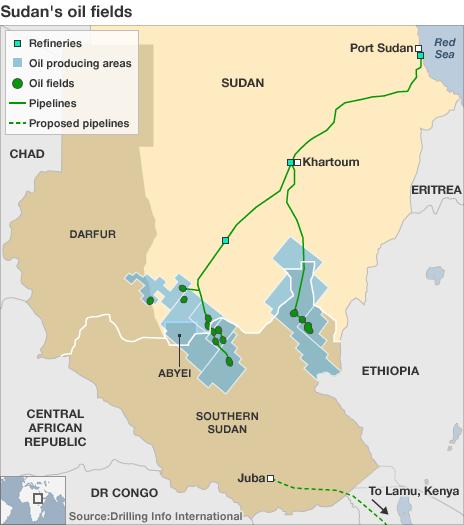
South Sudan remains entirely dependent on its northern neighbor, Sudan, to export its crude oil to international markets, using two main pipelines to Port Sudan on the Red Sea. The country currently has no significant storage capacity for refined products and relies on Sudan for all of its crude exports.
Existing pipeline infrastructure:
- PetroDar pipeline: This is the main pipeline, carrying the heavy, sweet Dar Blend crude from Blocks 3E and 7E (the Palogue and Adar Yale oil fields in the Melut Basin) to the Bashayer marine terminal at Port Sudan. It has a throughput capacity of approximately 100,000 bpd and a maximum capacity of 500,000 bpd. It normally carries about 60% of South Sudan's oil production.
- Disruption and recovery: The PetroDar pipeline has been severely hampered by shutdowns since February 2024. The malfunction was caused by gelling problems (solidification of the crude) due to the inability to deliver diesel for dilution, a problem exacerbated by conflict-related restrictions on access and fuel supply. This limited South Sudan's production to about 80,000 bpd in March 2024. However, as of June 10, 2025, oil exports through this pipeline have resumed after repairs, easing the economic pressure.
- Greater Nile pipeline: This pipeline carries oil from Blocks 1 and 5A (the Thar Jath and Mala oil fields) to the Bashayer terminal for export and to two refineries in the Sudanese cities of El-Obeid and Khartoum for domestic distribution in Sudan. It has a capacity of 250,000 bpd and is operated by the China National Petroleum Corporation (CNPC).
National refining capacity: Historically, South Sudan has not established and operated a significant oil refinery since its secession. The Bentiu oil refinery in Unity State began operations in 2021 with a refining capacity of 10,000 bpd. The government has ambitious plans to build four additional refineries by the end of the decade. Proposed projects include Akon (50,000 bpd capacity) and Gameza (100,000 bpd capacity). Trinity Energy was also in advanced preparation to build a 40,000 bpd refinery near the Palouch oil fields. In August 2024, Nile Petroleum Corporation (Nilepet) signed a memorandum of understanding (MoU) with the Chinese company Shengli Oilfield Keer Engineering and Construction Company (Sokec) to build a modern oil refinery and storage facilities in South Sudan. This aims to end dependence on fuel imports and reduce logistics costs. Discussions with CNPC also include plans to build a new refinery.
New export routes and downstream development: South Sudan is actively seeking to build new pipeline infrastructure, petroleum product storage tanks and crude oil storage facilities to strengthen its downstream capacity and reduce its dependence on neighboring Sudan. One major project is the China-backed South Sudan–Djibouti crude oil pipeline, which proposes a pipeline running from South Sudan's oil fields across Ethiopia and ending at the port of Djibouti. As of mid-2024, it is still in the planning phase, awaiting financing and final design. It is part of a broader $778 million infrastructure initiative with Ethiopia, which also includes the construction of a 220 km road linking Upper Nile State to the Ethiopian border. This alternative route aims to provide a safer and more stable outlet for oil exports, particularly given the volatility in northern Sudan, and to strengthen trade ties. Nile Services and Logistics Company (Nile SLC), a subsidiary of Nilepet, signed an MoU with the oil and gas company Zenith Energy to explore opportunities for building storage tanks, pipelines and crude oil storage facilities.
The detailed accounts of the rupture of the PetroDar pipeline , specifically due to gelling for lack of diesel and the inability to carry out repairs amid the conflict in Sudan , underscore South Sudan's extreme vulnerability at a "choke point." This reliance on a single, conflict-prone transit country for the vast majority of its government revenue (90%) represents an existential economic risk. Even with the recent repairs and the resumption of exports , the fundamental fragility of this lifeline remains, as the conflict in Sudan is ongoing and a short-term ceasefire is not expected. The current situation demonstrates that South Sudan's economic stability depends on external factors largely beyond its control. Consequently, the aggressive pursuit of the South Sudan–Djibouti pipeline is not merely an economic expansion strategy but a critical national-security and economic-sovereignty imperative. Its successful completion would fundamentally change South Sudan's geopolitical position, providing a vital alternative and significantly reducing its vulnerability to regional conflicts.
The multiple ongoing and planned initiatives for new refineries (Bentiu, Akon, Gameza, Sokec/Nilepet, CNPC discussions) coupled with the explicit goal of reducing dependence on imported fuels signal a deliberate, strategic shift toward domestic value addition in the oil sector. At the same time, the determined pursuit of the Djibouti pipeline project clearly indicates a strategic move away from exclusive reliance on Sudan for oil exports. Together, these efforts aim to strengthen South Sudan's energy security. South Sudan is attempting to gain greater control over its entire oil value chain, from extraction to refining and export. This strategic pivot is crucial for long-term energy security, lower import costs and the promotion of greater economic stability. It also signals significant opportunities for international investors in South Sudan's downstream sector , as the country seeks to build up its internal capacities and diversify its external ties.
Table 3: Overview of Main Pipeline Infrastructure
| Pipeline name | Origin/Destination | Main oil fields served | Capacity (barrels per day) | Operator/Ownership | Key features/Notes | Current status |
|---|---|---|---|---|---|---|
| PetroDar pipeline | Melut Basin (Blocks 3E, 7E) to Port Sudan | Palogue, Adar Yale | 100,000 (throughput), 500,000 (max) | Dar Petroleum Operating Company (DPOC) | Carries Dar Blend crude, gelling problems, crosses a conflict zone | Operational (resumed in June 2025) |
| Greater Nile pipeline | Blocks 1, 5A to Port Sudan and Sudanese refineries | Thar Jath, Mala | 250,000 | China National Petroleum Corporation (CNPC) / Greater Nile Petroleum Operating Company | Serves both export and domestic refining in Sudan | Operational |
| Proposed South Sudan–Djibouti pipeline | South Sudan oil fields via Ethiopia to the Port of Djibouti | N/A | N/A | China-backed | More stable alternative route, aims to reduce dependence on Sudan | In planning phase (awaiting financing) |
Export to Sheets
5. Key Industry Players and Operating Consortia
South Sudan's oil and gas market is characterized by a mix of global and local players, with a moderately fragmented competitive landscape in which no single company dominates.
National oil company:
- Nile Petroleum Corporation (Nilepet): As South Sudan's national oil and gas company, Nilepet plays a significant role in local oil production and infrastructure. It holds a strategic stake in every operating consortium in South Sudan, having assumed this role from Sudan's state oil company, Sudapet, after independence in 2011. Nilepet is actively involved in both the upstream (exploration and production) and downstream sectors. It is also exploring partnerships to strengthen production capacity and efficiency, and has signed MoUs for new refineries and storage facilities.
Main international players:
- China National Petroleum Corporation (CNPC): The dominant international investor and operator, CNPC holds a 41% stake in Dar Petroleum Operating Company (DPOC) and a 40% stake in Greater Nile Petroleum Operating Company (GPOC). CNPC operates the Greater Nile pipeline and carries out extensive exploration and production activities across several oil blocks. China has provided substantial investment in South Sudan's oil fields and infrastructure, including the pipeline to Port Sudan. CNPC is also involved in discussions on new cross-border pipeline and refinery projects.
- Petroliam Nasional Berhad (Petronas) (Malaysia): A crucial entity in exploration and investment strategies, Petronas holds a 40% stake in DPOC , 30% in GPOC , and a majority 67.8% stake in Sudd Petroleum Operating Company (SPOC). Petronas is involved in oil field development, focusing on production efficiency and leveraging strong technological capabilities.
- ONGC Videsh (India): The overseas arm of ONGC, it holds a 25% stake in GPOC and 24.2% in SPOC.
- Sinopec (China): Holds a 6% stake in DPOC.
- Tri-Ocean Energy: Holds a 5% stake in DPOC.
Main operating consortia:
- Dar Petroleum Operating Company (DPOC): This exploration and production company is based in Juba and operates Blocks 3 and 7 in the Melut Basin. Its shareholders are CNPC (41%), Petronas (40%), Nilepet (8%), Sinopec (6%) and Tri-Ocean Energy (5%). DPOC is currently the only oil and gas consortium producing significant volumes of oil in South Sudan, notably the Dar Blend crude.
- Greater Nile Petroleum Operating Company (GPOC): This consortium operates in Blocks 1A and 1B, which contain the oil-rich Unity field. Its ownership is made up of CNPC (40%), Petronas (30%), ONGC Videsh (25%) and Nilepet (5%). Production in this area restarted after having been the epicenter of violence since 2013.
- Sudd Petroleum Operating Company (SPOC): This company operates Block 5A (Thar Jath). Its ownership includes Petronas (67.8%), ONGC Videsh (24.2%) and Nilepet (8%). Production in Block 5A resumed in January 2021.
- Refining companies: Akon Refinery Company Ltd. specializes in refining crude oil to meet local demand. Shengli Oilfield Keer Engineering and Construction Company (Sokec) is a Chinese company that signed an MoU with Nilepet to build a new modern oil refinery and storage facilities.
A comprehensive review of the shareholding structures of the main operating consortia (DPOC, GPOC, SPOC) reveals that an overwhelming majority of the stakes are held by state-owned or state-linked companies from Asian countries, notably China (CNPC, Sinopec), Malaysia (Petronas) and India (ONGC Videsh). China, in particular, has a long history of significant investment in South Sudan's oil fields and infrastructure and is now at the center of new strategic infrastructure plans, including alternative pipelines and refineries. This contrasts with the departure of most other foreign investors by 2020. This pattern highlights a strong "South-South" cooperation model dominating South Sudan's energy sector. The deep involvement of these Asian national oil companies suggests that their respective national energy-security interests are considerably tied to the stability and productivity of South Sudan's oil sector. It also implies that future development and investment will likely continue to be strongly influenced by these key Asian partners.
Nilepet, as the national oil company, holds a mandatory stake in every operating consortium and is increasingly proactive in seeking new partnerships for the development of critical infrastructure, including refining and storage facilities. In addition, Nilepet has set up a training and development center. This goes beyond mere revenue collection; it indicates a deliberate and evolving strategy by the South Sudanese government to assert greater national control over its oil sector and to build indigenous capacity along the value chain. Nilepet's growing and more active role is crucial to South Sudan's long-term goals of achieving greater energy security and self-sufficiency. By fostering local expertise and engaging directly in strategic projects, Nilepet has the potential to reduce the country's historical reliance on foreign technical assistance and management, thereby contributing to more sustainable and nationally beneficial development of its oil resources.
Table 4: Main Oil and Gas Companies Operating in South Sudan and Their Roles
| Company/Consortium | Type | Key shareholders/Ownership structure | Main blocks/fields operated | Key activities/Role | Notes |
|---|---|---|---|---|---|
| Nile Petroleum Corporation (Nilepet) | National oil company (NOC) | State of South Sudan (holds stakes in all consortia) | All operating blocks | E&P, Downstream, Training, Resource management | Growing role in national management and capacity building; exploring partnerships for production and efficiency |
| China National Petroleum Corporation (CNPC) | International oil company (IOC) | N/A | Blocks 3, 7 (DPOC), Blocks 1A, 1B (GPOC) | E&P, Pipeline operation, Investment | Largest shareholder in DPOC (41%) and GPOC (40%); major infrastructure investments |
| Petroliam Nasional Berhad (Petronas) | International oil company (IOC) | N/A | Blocks 3, 7 (DPOC), Blocks 1A, 1B (GPOC), Block 5A (SPOC) | E&P, Oil field development | Major shareholder in DPOC (40%), GPOC (30%), SPOC (67.8%); focus on production efficiency |
| ONGC Videsh | International oil company (IOC) | N/A | Blocks 1A, 1B (GPOC), Block 5A (SPOC) | E&P | Shareholder in GPOC (25%) and SPOC (24.2%) |
| Sinopec | International oil company (IOC) | N/A | Blocks 3, 7 (DPOC) | E&P | Shareholder in DPOC (6%) |
| Tri-Ocean Energy | International oil company (IOC) | N/A | Blocks 3, 7 (DPOC) | E&P | Shareholder in DPOC (5%) |
| Dar Petroleum Operating Company (DPOC) | Operating consortium | CNPC (41%), Petronas (40%), Nilepet (8%), Sinopec (6%), Tri-Ocean Energy (5%) | Blocks 3, 7 (Melut Basin) | E&P (Dar Blend crude production) | Currently the only consortium producing significant volumes; based in Juba |
| Greater Nile Petroleum Operating Company (GPOC) | Operating consortium | CNPC (40%), Petronas (30%), ONGC Videsh (25%), Nilepet (5%) | Blocks 1A, 1B (Unity field) | E&P | Production restarted after periods of violence |
| Sudd Petroleum Operating Company (SPOC) | Operating consortium | Petronas (67.8%), ONGC Videsh (24.2%), Nilepet (8%) | Block 5A (Thar Jath) | E&P | Production restarted in January 2021 |
| Akon Refinery Company Ltd. | Local refiner | N/A | N/A | Crude oil refining | Contributes to refining capacity and local fuel supply; focuses on meeting local demand and export |
| Shengli Oilfield Keer Engineering and Construction Company (Sokec) | Chinese company (engineering/construction) | N/A | N/A | Construction of refineries and storage facilities | Partnership with Nilepet for new refining infrastructure |
Export to Sheets
6. Major Challenges and Risks
South Sudan's oil sector faces a multitude of challenges and risks, many of which are interdependent and complex.
Conflict in Sudan and infrastructure vulnerability: The civil war in Sudan, which broke out in April 2023, has had a profound impact on South Sudan's oil sector. Fighting has concentrated around key production, processing and export infrastructure, posing a substantial risk of disruption to national production and international trade. The most direct impact was the rupture of the PetroDar pipeline in February 2024, which halted approximately 60% of South Sudan's oil exports. This malfunction was due to gelling problems caused by the inability to deliver diesel for dilution, with access and repairs severely hampered by the conflict. Although exports resumed in June 2025 , the underlying risk remains high, as no short-term ceasefire is expected in Sudan. This critical dependence on infrastructure crossing a conflict zone exposes South Sudan to immediate and severe external shocks, underscoring the precariousness of its main source of revenue.
Internal political instability: South Sudan's post-independence period was "immediately marked by internal armed conflict and instability." This "continued internal instability" has undermined the country's ability to ramp up its oil production to full capacity and has contributed to low investor confidence. Ongoing fighting, as of January 2024, has spread to other parts of the country, increasing the risk of shutdowns or damage to oil infrastructure. The inability to ensure a stable and secure environment deters the investment needed to expand and modernize the sector.
Governance and financial management problems: Despite substantial oil revenues, South Sudan's economy is stagnant, with widespread poverty and a lack of infrastructure, largely because of a "kleptocratic system of government" and the poor quality of institutions and governance. There is evidence of complex, opaque financial flows and weak governance within the oil sector. Mismanagement of energy resources is a major challenge. Domestic fuel prices in Sudan (and by extension, affecting South Sudan's supply) are among the lowest in the world because of heavy government subsidies, which distorts the market and increases the need for fuel imports as domestic production cannot meet demand. The use of "multiple exchange rates" by oil companies further complicates financial transparency and operations. Risks to revenue include the "long-standing practices of oil presales" , indicating a lack of transparency and potential future revenue shortfalls. These governance problems undermine the country's ability to fully leverage its oil wealth for national development.
Infrastructure and upstream investment deficits: A "general lack of energy infrastructure" is cited as a major challenge. Insufficient upstream investment has led to stagnant growth in oil production. A significant challenge is the lack of interest from new foreign investors. Most foreign investors (with the exception of CNPC) left Sudan by 2020 after their contracts ended. Despite the lifting of U.S. economic sanctions in 2017, no new foreign investor has shown interest in the 15 blocks offered, which mainly reflects underlying weaknesses in governance and policy. The country's heavy reliance on external partners for technical expertise and investment is also a challenge. The absence of sustained upstream investment limits South Sudan's ability to maximize its production potential and reach its ambitious targets.
Conclusions
South Sudan's oil and gas sector stands at a critical crossroads, characterized by near-total economic dependence, acute infrastructure vulnerability and strategic efforts to diversify its export routes and strengthen its domestic capabilities. The recent resumption of oil exports via Sudan, following pipeline repairs, offers vital economic respite and a projected exit from recession. However, this immediate improvement does not mask the country's inherent structural fragility, as its economic survival remains hanging on transit infrastructure crossing an active conflict zone.
South Sudan strikingly embodies the "resource curse," in which substantial oil wealth has failed to translate into broad-based economic development or improved living conditions for its population. Deep-seated problems of governance, kleptocracy and opaque revenue management have stifled investment and diversification, leaving the economy stagnant and vulnerable to external shocks.
The recent crisis has catalyzed a strategic awakening, pushing South Sudan to invest heavily in alternative infrastructure, notably the South Sudan–Djibouti pipeline project, and to develop its domestic refining capacity. These initiatives, often backed by Asian companies, particularly Chinese ones, aim to reduce dependence on Sudan and strengthen the country's energy sovereignty. The growing role of Nilepet, the national oil company, in the management and development of the sector is a positive sign of the assertion of national control.
To ensure lasting stability and prosperity, South Sudan must not only secure its export routes and develop its capabilities, but also tackle systemic governance and transparency problems head-on. Implementing robust legislation on oil revenue management, auditing and procurement is essential to ensure accountability and transparency. Economic diversification into sectors such as agriculture and renewable natural resources is also imperative to build a more resilient economy that is less dependent on oil market fluctuations and regional conflicts. Without these fundamental reforms, South Sudan's oil potential will remain a driver of instability rather than a catalyst for inclusive development.


 Sudan
 Uganda