Oil Exploration
A detailed look at the techniques used to discover oil and gas fields, the geophysical and geological tools involved, and the major players in the upstream phase.
 By the editorial teamPetrole.Africa
🎯 Learning Objective
To explain in detail the techniques used to discover oil and gas fields, the geophysical and geological tools involved, and the major players in this upstream phase of the petroleum industry.
I. 🔍 What Is Oil Exploration?
Oil exploration is the first step in the petroleum value chain. It consists of identifying, locating and evaluating geological structures that may contain commercially exploitable hydrocarbons.
This phase requires very high levels of investment (an exploration well costs several million dollars), with no guarantee of success. It combines geology, geophysics, engineering, modeling and data analysis.
II. 🗺️ Stages of Exploration
| Stage | Objective | Main Activities |
|---|---|---|
| 1. Regional studies | Identify promising basins | Geological analysis, existing data |
| 2. Geophysical surveying | Visualize deep structures | Gravimetry, magnetometry, seismic |
| 3. Structural mapping | Delineate potential traps | Seismic interpretation, models |
| 4. Exploration drilling | Verify the presence of hydrocarbons | Test wells, logging, coring |
| 5. Appraisal | Estimate field volumes and quality | Formation tests, reservoir modeling |
III. 🌐 Geophysical Exploration Methods
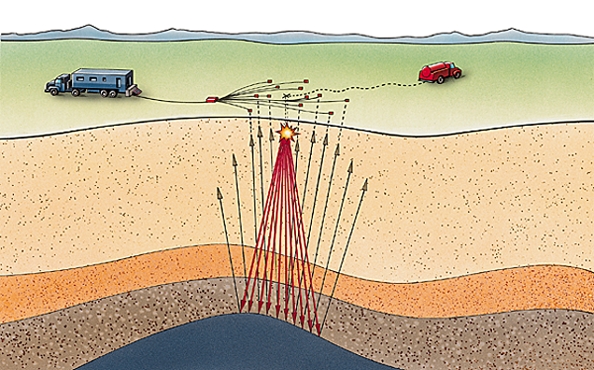
1. Reflection Seismic
🔊 Principle: acoustic waves are sent into the subsurface and their reflection off the various geological layers is analyzed.
- 2D: Linear profiles
- 3D: Full volume – more accurate imaging
- 4D: Monitoring the same reservoir over time (production monitoring)
Tools:
- Vibroseis trucks (onshore)
- Air guns (offshore)
- Hydrophones / geophones
Interpretation:
- Anticlines, faults, salt domes, turbidite channels…
2. Gravimetry and Magnetometry
- Gravimetry: detects variations in rock density (sedimentary basin vs. basement)
- Magnetometry: measures magnetic anomalies (lithology, faults)
Used in the preliminary phase to delineate basins before seismic acquisition.
IV. 🧪 Geological and Petrophysical Studies
- Geological maps: lithostratigraphy, faults, folds
- Sedimentary cross-sections: analysis of rock sequences
- Geological probes: exploration wells with logs:
- Gamma ray (shale content)
- Density / porosity
- Resistivity (fluid saturation)
- Drilling cores: mineralogical studies, porosity, presence of kerogen
V. 🧠 Data Modeling and Integration
Geoscientists use specialized software to integrate seismic, geological and petrophysical data in order to build a 3D model of the subsurface.
Most widely used software:
- Schlumberger Petrel
- CGG Geovation
- IHS Kingdom
- Paradigm (Emerson)
These models make it possible to determine recoverable volumes and guide future drilling.
VI. 💰 Cost, Risks and Success Rates
- An offshore exploration well can cost between $50 million and $150 million.
- The overall success rate of global exploration is 20–30%, but can drop to 10% in new, little-known areas.
🔺 Main Risks
- Absence of source rock or inefficient migration
- Impermeable or excessively deep reservoir
- Non-commercial fluid (saltwater, bitumen)
VII. 🌍 Exploration Players
A. Oil Companies
- Majors: TotalEnergies, Shell, ExxonMobil, Chevron…
- Super-independents: Hess, Apache, Kosmos Energy…
- Juniors: Petrotal, Africa Oil, Tullow Oil…
B. African National Oil Companies
| Country | National Company |
|---|---|
| Nigeria | NNPC Limited |
| Angola | Sonangol |
| Algeria | Sonatrach |
| Gabon | Gabon Oil Company |
| Côte d’Ivoire | PETROCI |
| Ghana | GNPC |
C. Service Providers
- SLB (Schlumberger), Halliburton, CGG, Baker Hughes
- They provide seismic engineering, drilling, logging services and geochemistry
VIII. 📌 African Case Study: The Success of Offshore Exploration in Mauritania-Senegal
- A coastal basin that was little explored until 2014
- Major gas discovery by Kosmos Energy / BP (the Greater Tortue Ahmeyim field)
- Reserves estimated at more than 450 billion cubic meters of gas
- Production start-up expected between 2024 and 2025
Conclusion: Africa remains a continent with strong exploration potential, particularly in deepwater offshore.
🧾 Glossary
- Wildcat well: the first well drilled in an area with no petroleum history
- 3D seismic: a volumetric subsurface imaging method using acoustic waves
- Well log: a continuous recording of the physical properties of the rock
- Prospect: a geological structure identified as potentially oil-bearing
- Dry hole: a well drilled without a commercial discovery
📚 Resources
- 📄 PDF: Geophysical Methods in Petroleum Exploration
- 🎥 Video: How to Interpret a 3D Seismic Survey?
- 🔗 Course: IFP School – Geophysical Exploration of Petroleum Basins
🧠 Key Takeaways
- Exploration is a complex, multidisciplinary science at the crossroads of geophysics, geology, engineering and numerical modeling.
- It is risky and costly, but absolutely essential to feed the petroleum value chain.
- Africa still offers large unexplored or under-explored areas, particularly offshore.